

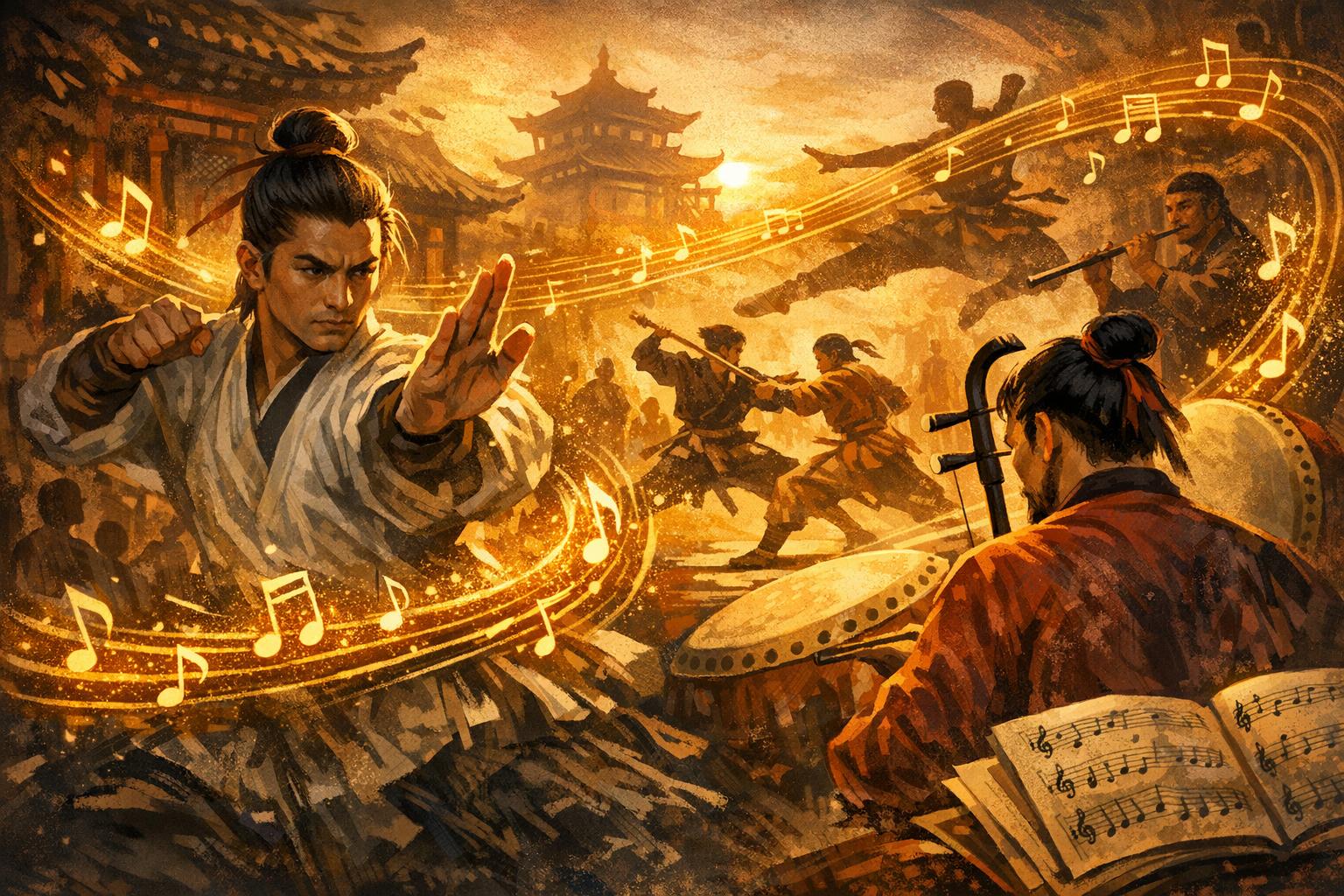
Introduction to Kung Fu and Its Connection with Music
In the realm of martial arts, Kung Fu is widely recognized for its complex techniques, disciplined practice methods, and philosophical foundations. Beyond its combative applications, Kung Fu has long functioned as a performative art form in which physical movement becomes a medium for communication. Within this performative dimension, music plays a central and enduring role. The interaction between sound and motion transforms technical demonstrations into structured narratives that communicate history, identity, and values.
Kung Fu is not simply a system of self-defense; it is embedded in broader Chinese cultural traditions that encompass opera, ritual, literature, and dance. In many of these traditions, music guides rhythm, determines pacing, and signals transitions. When combined with martial technique, music enhances clarity and cohesion, ensuring that audiences can follow the progression of events conveyed through stylized movement. Over centuries, this fusion has developed into a sophisticated expressive system in which rhythm, melody, and percussion interact directly with physical form.
The connection between Kung Fu and music extends from rural festivals and temple fairs to staged theatrical productions and contemporary cinema. While the scale and instrumentation may vary across contexts, the fundamental principle remains consistent: sound structures the narrative space in which martial movement unfolds. This relationship continues to evolve while preserving elements rooted in historical practice.
The Historical Context of Music in Kung Fu
The integration of music into Kung Fu can be traced to early public demonstrations and regional performance traditions. In historical village settings, martial artists often performed during seasonal festivals, religious ceremonies, and community celebrations. These events frequently included musicians who provided rhythmic accompaniment. Drums and gongs were especially prominent because they could project sound over large outdoor spaces and clearly mark tempo.
In southern China, lion dance performances provide a clear example of the longstanding relationship between martial arts and music. Many lion dance troupes originated within Kung Fu schools, and practitioners trained both in combat techniques and choreographed routines. The lion’s movements are synchronized precisely with drum patterns, cymbal crashes, and gong strikes. Each rhythmic cue signals a change in posture, direction, or energy level. Without the musical structure, the performance would lose coherence and symbolic meaning.
Traditional Chinese opera also influenced martial arts presentations. Opera performers trained in acrobatics and stylized combat, and their choreographed battles were tightly aligned with orchestral cues. The exchange between martial arts practitioners and opera artists led to shared conventions in posture, gesture, and timing. Musical signals marked the entrance of characters, shifts in emotional tone, and climactic confrontations. Consequently, martial artists adopted similar techniques when staging public displays.
Instrumentation historically associated with Kung Fu performances includes the luo (gong), gu (drum), and erhu (two-stringed bowed instrument). The drum typically establishes a steady pulse, reinforcing the practitioner’s stance transitions and strikes. The gong accentuates decisive moments such as leaps or weapon clashes. String instruments provide melodic context, often associated with reflective or transitional sequences. Together, these elements form a soundscape that frames the visual display.
Music as a Narrative Tool in Kung Fu
Music functions as more than background accompaniment; it serves as an organizing and interpretive framework. In staged martial narratives, performers rely on musical structure to define phases of conflict and resolution. An opening rhythm may establish the environment, while subsequent variations introduce tension or escalation. As the choreography intensifies, tempo and volume often increase, aligning sonic growth with physical momentum.
This narrative shaping is especially visible in duel sequences. At the outset, percussion may remain restrained, reflecting caution between opponents. As exchanges become more rapid, rhythmic density expands. Crescendos frequently coincide with airborne techniques or weapon collisions, creating synchronized audiovisual emphasis. When conflict resolves, the music may shift into a steady cadence, signaling conclusion and restoring equilibrium.
Melodic motifs also contribute to storytelling clarity. A recurring phrase can represent a specific character or school of martial arts. When that phrase reappears, audiences subconsciously associate it with previously established traits or themes. In this way, music parallels literary devices such as repetition and foreshadowing. The result is a multilayered narrative in which viewers interpret both movement and sound simultaneously.
Silence, or minimal instrumentation, is another deliberate narrative strategy. Strategic pauses in percussion can magnify anticipation before a decisive action. By temporarily removing rhythmic guidance, performers create contrast that heightens audience attention. When the music resumes, its impact is amplified through comparison with the preceding quiet interval.
Impact of Music on Visual and Emotional Elements
Although Kung Fu emphasizes discipline and precision, performances often portray internal conflict, moral dilemmas, and shifting alliances. Music clarifies these thematic elements by shaping interpretive context. Minor tonalities may accompany moments of uncertainty, while brighter melodic passages may correspond with demonstrations of mastery or resolution. This coordination ensures that abstract ideas become perceptible through sensory cues.
The visual dimension of Kung Fu includes rapid directional changes, varied elevations, and contrasting tempos within a single routine. Music reinforces these contrasts by modulating pace and intensity. For example, a slow, sustained bow stroke on the erhu can complement controlled breathing and extended stances. In contrast, rapid drum sequences support spinning kicks or series of strikes. By aligning auditory and kinetic patterns, performers create a coherent aesthetic structure.
Synchronization also enhances spatial awareness. In group demonstrations, multiple practitioners execute coordinated sequences. Musical rhythm ensures collective timing, preventing fragmentation. The drumbeat becomes a shared reference point, allowing participants to maintain uniform spacing and cadence. This organizational function is particularly vital during complex formations involving weapons or acrobatic elements.
Weapon-based routines illustrate further the impact of musical framing. The clash of metal against metal may be reinforced by cymbal accents, intensifying perceived force. Staff routines often align with heavy drum pulses that emphasize grounded stability. Flexible weapons such as the chain whip may be paired with lighter, faster rhythms, highlighting fluidity. Each association between instrument and motion supports audience interpretation without verbal explanation.
Costume and staging also interact with music. Flowing garments respond visually to rhythmic shifts, amplifying rotational movements. When percussion accelerates, fabric movement appears more dynamic, creating layered sensory input. Thus, music operates as an integrative element that connects choreography, costume, and staging into a unified presentation.
Training and Internal Rhythm
Beyond performance, music influences daily practice within some Kung Fu schools. Instructors may employ rhythmic counting or recorded percussion during basic drills. This structured timing helps students regulate breathing and maintain consistent technique. Repetition aligned with steady tempo strengthens muscle memory and coordination.
Forms practice, known as taolu, often contains an inherent rhythmic blueprint even when executed without external accompaniment. Practitioners internalize cadence through breathing patterns and transitional pacing. When live music is later added, it aligns with this preexisting structure. Consequently, music reflects rather than dictates movement logic, revealing the embedded rhythm already present within the form.
Advanced practitioners sometimes describe performance as a dialogue between internal and external tempo. The body maintains control over acceleration and deceleration, while percussion accents confirm structural milestones. This interaction exemplifies how music becomes an extension of disciplined training rather than a superficial addition.
Regional Variations in Musical Integration
Different regional styles of Kung Fu demonstrate varied approaches to musical accompaniment. Northern styles, characterized by expansive kicks and acrobatic leaps, often pair effectively with brisk tempos and emphatic percussion. Southern styles, known for compact stances and close-range techniques, may favor measured rhythms that accentuate grounded stability.
Folk traditions further diversify musical application. In some coastal regions, wind instruments complement martial displays during temple festivals. In inland provinces, heavier percussion ensembles dominate public demonstrations. Despite these differences, the underlying principle remains the same: music frames motion and contextualizes technique within cultural identity.
Modern Applications of Music in Kung Fu Cinema
The emergence of cinema in the twentieth century expanded the reach of Kung Fu storytelling. Film introduced new possibilities for editing, orchestration, and sound design. Directors began collaborating closely with composers to produce scores that correspond precisely with choreography. In this medium, music not only accompanies performance but also guides audience perception through selective emphasis and repetition.
In contemporary martial arts films, orchestral compositions often merge traditional Chinese instruments with Western symphonic elements. This hybrid approach reflects the global audience for Kung Fu narratives. Large string sections provide harmonic depth, while traditional percussion preserves cultural resonance. Electronic enhancements may be added to intensify modern action sequences.
Film editing techniques allow for precise synchronization between strike and soundtrack. A single drumbeat can coincide exactly with a punch, reinforcing impact. Slow-motion sequences may stretch musical phrases to align with extended visual frames. Conversely, rapid montage editing can pair with escalating rhythmic complexity, heightening kinetic clarity.
Directors known for meticulous visual composition frequently regard music as an equal partner to cinematography. Color palettes, camera angles, and soundtrack choices interact to create thematic unity. A restrained melodic line may accompany scenes emphasizing discipline and introspection, while expansive orchestration may frame large-scale battles. In each case, music shapes narrative interpretation without requiring explicit exposition.
Contemporary composers working within the genre often study traditional rhythmic structures before adapting them for modern production. By retaining recognizable motifs from folk percussion patterns, they maintain continuity with historical precedents. At the same time, digital recording technologies permit broader dynamic range and spatial sound design, enhancing immersion for theater audiences.
Global Influence and Cross-Cultural Exchange
The international circulation of Kung Fu cinema has influenced global perceptions of martial arts and their musical associations. Audiences outside China frequently encounter Kung Fu narratives first through film, where soundtrack choices shape expectation. As a result, certain rhythmic patterns and instrumental timbres have become widely associated with martial arts imagery.
This cross-cultural exchange has also encouraged experimentation. International composers sometimes incorporate hip-hop beats, electronic textures, or minimalist orchestration into martial arts productions. While these adaptations differ from traditional festival accompaniments, they follow the same structural principle: sound organizes motion and enhances narrative coherence.
Stage productions outside China have adopted similar practices. Touring martial arts ensembles often collaborate with local musicians, blending regional instruments with traditional Chinese percussion. Such collaborations illustrate the adaptability of the Kung Fu and music partnership, demonstrating its capacity to function across cultural contexts without losing structural integrity.
Conclusion
The sustained interaction between Kung Fu and music reveals a complex artistic partnership grounded in history, pedagogy, and performance. From village festivals to international cinema, sound has structured the pacing, emphasis, and interpretive clarity of martial demonstrations. Drums, gongs, string instruments, and orchestral scores each contribute distinct layers that align with choreographic intent.
Music operates simultaneously as rhythmic guide, narrative framework, and cultural signifier. It synchronizes collective movement, underscores shifts in conflict, and bridges transitions between tension and resolution. In training contexts, rhythm strengthens discipline and coordination, embedding temporal awareness within physical practice. In cinematic contexts, composed scores expand narrative reach and connect traditional forms to global audiences.
The relationship between Kung Fu and music demonstrates how martial technique can function within a broader artistic system. When combined, structured movement and intentional sound design transform physical demonstration into a cohesive story. This integrated approach has persisted across centuries because it supports both technical precision and interpretive depth. As performance mediums continue to evolve, the collaboration between martial arts and music remains a defining feature of Kung Fu’s enduring cultural presence.
This article was last updated on: April 28, 2026