

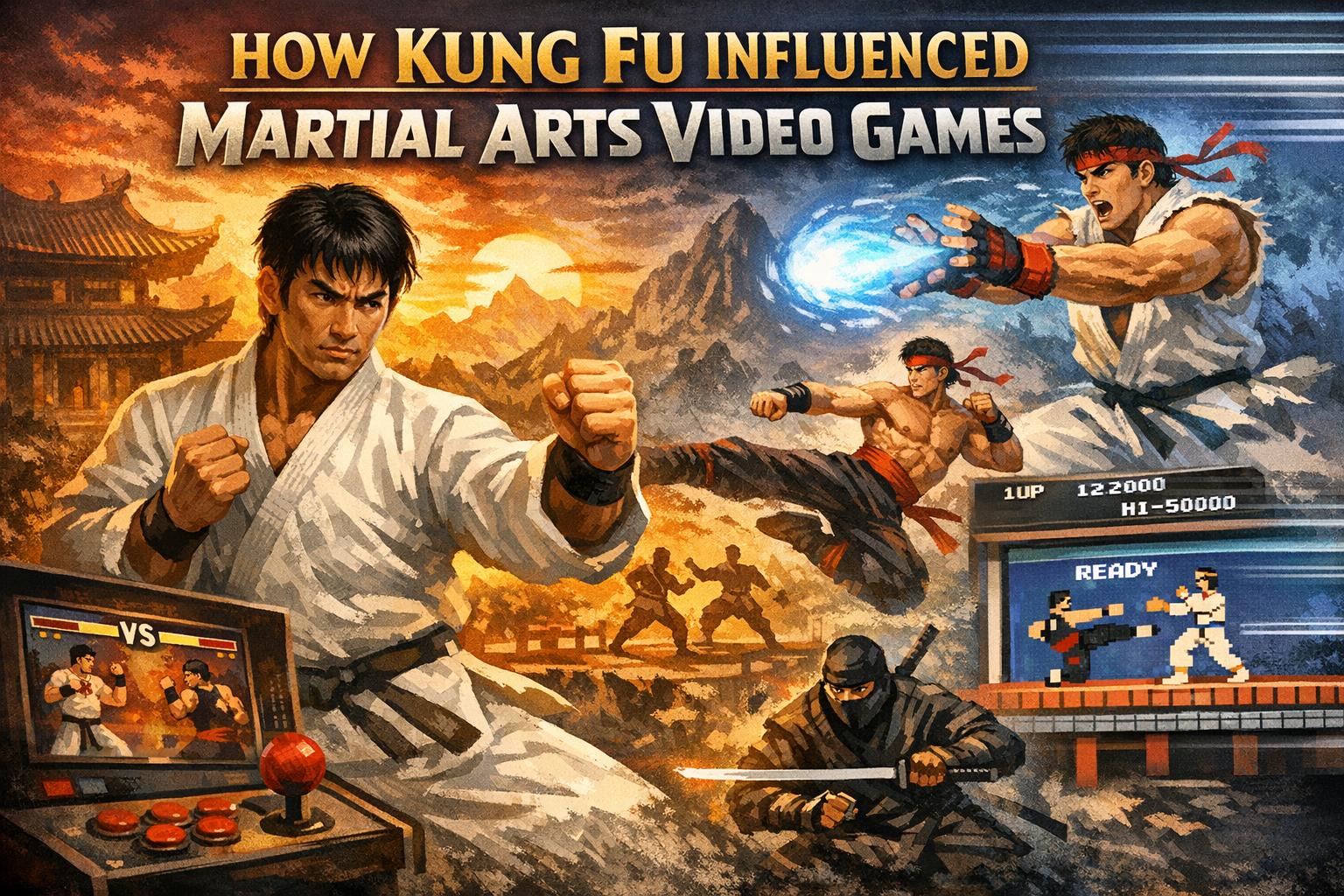
The Influence of Kung Fu on Martial Arts Video Games
Kung Fu, a traditional Chinese martial art encompassing a wide range of fighting systems, philosophies, and training methods, has exerted a sustained and measurable influence on the design and evolution of martial arts video games. From the earliest arcade machines to modern console and PC titles, the structure of combat systems, character archetypes, animation styles, and narrative frameworks has often reflected principles associated with Kung Fu practice. This influence is not limited to visual imitation; it extends to the conceptual foundations of how digital combat is organized, taught to players, and refined over time.
The legacy of Kung Fu in video games can be traced to the early popularity of martial arts cinema in the 1970s and 1980s. As arcade technology matured, developers drew heavily from the imagery and choreography of Kung Fu films. However, beyond cinematic inspiration, the deeper mechanics of traditional training, such as progressive skill acquisition, memorization of forms, and mastery through repetition, found direct parallels in game design. These parallels contributed to the steady integration of Kung Fu-inspired systems into interactive entertainment.
Game Mechanics and Movements
Kung Fu is characterized by a broad technical vocabulary that includes striking, grappling, joint manipulation, acrobatics, and weapon forms. This diversity provided developers with a substantial source of mechanical inspiration. In martial arts video games, especially one-on-one fighting games and side-scrolling action titles, player movesets often mirror authentic techniques drawn from styles such as Shaolin, Wing Chun, Hung Gar, and Tai Chi. While digital adaptations simplify these techniques for accessibility, the structural origins remain identifiable.
A notable contribution of Kung Fu to game mechanics is the emphasis on stance-based combat. Traditional Kung Fu training begins with foundational stances that determine balance, mobility, and attack potential. In games, similar principles appear in character positioning, guard states, and footwork mechanics. Some titles allow players to shift between offensive and defensive stances, subtly echoing real-world practice where weight distribution and posture determine the flow of engagement.
The concept of combining moves into structured sequences also derives from Kung Fu forms, known as taolu. These choreographed routines train practitioners to link strikes, blocks, and transitions seamlessly. Fighting games replicate this idea through combo systems. Players learn specific input patterns to execute multi-hit combinations that require timing and precision. While technologically driven, these mechanics parallel the coordinated movements of traditional routines.
Defensive maneuvers in games have similarly benefited from Kung Fu’s legacy. Parrying, redirection of force, and counterattacks—central to many internal and external Kung Fu styles—are frequently integrated into gameplay systems. Titles that prioritize timing-based counters or energy redirection often draw conceptual influence from principles found in Tai Chi or other soft styles, where the opponent’s force is neutralized rather than directly opposed.
Weapon-based combat also traces roots to Kung Fu traditions. Classical training includes swords, staffs, polearms, and other instruments. Many action-adventure games incorporate analogous weapon categories, with animations inspired by authentic techniques. Even when stylized for dramatic effect, the rotational movements, sweeping arcs, and defensive flourishes reflect real martial patterns adapted for digital execution.
In addition, progression systems in martial arts games often simulate the structured advancement typical of traditional training. Players unlock techniques gradually, reinforcing the idea of disciplined improvement. This mirrors the step-by-step curriculum experienced by Kung Fu students, who master fundamentals before attempting complex sequences. The result is a gameplay loop built around incremental mastery rather than immediate access to advanced abilities.
Character Archetypes and Storylines
Kung Fu’s influence extends well beyond physical mechanics into the thematic construction of characters and narratives. Video games frequently incorporate archetypes that resonate with traditional martial lore. The disciplined apprentice, the wandering master, the rival student, and the reclusive hermit sage each have roots in centuries of martial storytelling. Game narratives adapt these figures to interactive formats while preserving their structural roles.
The student-mentor relationship remains one of the most enduring frameworks. In traditional settings, skill transmission occurs through long-term personal guidance. Video games replicate this dynamic through training sequences, tutorial characters, or narrative mentors who impart new abilities. This approach integrates instruction into storytelling, maintaining immersion while guiding player development.
Another recurring theme is the pursuit of self-improvement. Many martial arts games structure their storylines around tournaments, revenge quests, or journeys of personal redemption. These arcs align with the philosophical underpinnings of Kung Fu, where mastery is seen as both physical and mental cultivation. Characters frequently face internal challenges alongside external adversaries, reinforcing the link between discipline and growth.
Moral codes associated with Kung Fu traditions also appear in characterization. Protagonists are often portrayed as restrained but capable, acting according to principles of respect and honor rather than aggression. Antagonists, by contrast, may represent corruption of martial knowledge or misuse of power. This thematic contrast reinforces the ethical dimension commonly embedded in classical martial narratives.
The integration of lineage and legacy further demonstrates Kung Fu’s narrative influence. Some games introduce rival schools or fractured traditions that compete for supremacy. These rivalries resemble historical divisions among martial arts lineages, adapted into dramatic storytelling devices. By anchoring characters within specific traditions, developers create depth that mirrors real-world martial diversity.
Aesthetic and Visual Presentation
Visual design in martial arts video games has frequently reflected aesthetic traditions associated with Kung Fu culture. Environmental settings often include temples, mountain monasteries, bamboo forests, and classical courtyards. These backdrops reference historical training spaces depicted in martial literature and cinema. Through careful environmental modeling, games construct atmospheres that evoke cultural continuity.
Costume design similarly draws from traditional attire. Flowing robes, sleeveless tunics, cloth shoes, and sashes appear regularly in character wardrobes. While stylized for visual clarity and dynamic animation, these garments maintain recognizable ties to martial uniforms. Weapons are depicted with ornamental details consistent with historical craftsmanship, reinforcing authenticity within stylized constraints.
Animation techniques provide perhaps the most direct aesthetic link. Kung Fu emphasizes fluidity, balance, and rhythmic motion. Developers have invested considerable effort in motion capture and frame-by-frame animation to convey similar qualities. Even in exaggerated fantasy settings, character movements frequently retain an underlying structure derived from real martial choreography.
Cinematic presentation also owes much to Kung Fu film traditions. Dramatic camera angles, slow-motion sequences, and focused duel settings replicate visual motifs established in martial arts cinema. The translation of these techniques into interactive media allows players to participate in choreographed spectacles while retaining agency over movement and timing.
Sound design contributes to aesthetic consistency. The inclusion of traditional instruments, environmental ambience, and stylized impact effects helps situate gameplay within a cultural framework reminiscent of classical settings. Although adapted for global audiences, these choices reflect sustained engagement with the imagery and acoustics associated with Kung Fu.
Philosophical Themes and Systems Design
Beyond mechanics and appearance, Kung Fu has informed broader systems design philosophies in video games. Many martial arts titles adopt progression structures that echo the meditative and disciplined aspects of traditional practice. Training modes function as digital analogues to repetitive drills, where mastery emerges through structured repetition rather than random experimentation.
Energy systems in games often parallel the concept of qi, commonly translated as vital energy. While stylized and detached from traditional medical or philosophical interpretations, these systems allow players to accumulate and release power strategically. Special attacks or enhanced states represent controlled bursts of energy, abstracted into accessible gameplay mechanics.
Balance plays a central conceptual role. In Kung Fu theory, effective practice requires equilibrium between strength and adaptability. Game designers have adopted similar principles when calibrating character abilities. Competitive balance ensures that no single style or fighter dominates without strategic depth. This dynamic equilibrium reflects an implicit adaptation of martial philosophy into algorithmic design.
Patience and timing, emphasized in many internal styles, also shape gameplay pacing. Titles that reward defensive play, measured counterattacks, and strategic spacing encourage a rhythm analogous to martial sparring. In such systems, success depends not on rapid button pressing alone but on observational skill and controlled execution.
Global Dissemination and Cultural Exchange
As video games became a global medium, Kung Fu-inspired elements facilitated cross-cultural exchange. Developers from Japan, North America, Europe, and China have each interpreted traditional material through their own creative frameworks. This ongoing reinterpretation demonstrates how martial traditions can be adapted into digital storytelling without remaining fixed in a single national context.
Arcade fighting games of the late twentieth century popularized stylized interpretations of Chinese martial artists for international audiences. Later titles pursued higher levels of historical and architectural fidelity, reflecting increased access to research and motion capture references. Independent studios have further expanded the range of representation by focusing on grounded depictions of specific regional styles.
This global circulation has influenced player expectations. Audiences now recognize certain visual and mechanical cues—such as disciplined stances or flowing robe animations—as markers of martial authenticity. These shared references form a transnational vocabulary rooted in Kung Fu heritage but mediated through interactive technology.
Impact on the Gaming Industry
Within the broader industry, Kung Fu-inspired design established benchmarks for the martial arts genre. Early commercial successes demonstrated that audiences valued mechanically deep combat systems modeled after structured martial frameworks. As hardware capabilities increased, developers expanded these systems with more detailed animations and intricate combos, maintaining the foundational emphasis on technique.
Successful franchises built around martial arts themes became cultural touchstones, influencing character design and combat logic in unrelated genres. Role-playing games, action-adventure titles, and even multiplayer online games incorporated martial arts-inspired classes and skill trees. These integrations illustrate how Kung Fu’s structured movement systems proved adaptable across varied gameplay contexts.
Esports and competitive gaming communities further reinforce this legacy. Tournament play emphasizes precision, memorization, adaptability, and psychological discipline—qualities consistent with martial training philosophies. While separated from physical practice, the mental discipline required for high-level play mirrors elements traditionally associated with mastery in Kung Fu.
Technological innovation continues to expand these influences. Motion-tracking systems and virtual reality platforms aim to replicate realistic martial movements more directly. Although still evolving, such technologies revisit the foundational inspiration of traditional practice, seeking closer alignment between physical and digital execution.
In summary, Kung Fu’s impact on martial arts video games operates across multiple layers of design and representation. Its technical vocabulary informs combat systems and animation. Its narrative traditions shape character arcs and moral conflicts. Its aesthetic heritage defines environments, costumes, and cinematic framing. Its philosophical principles guide progression systems and balance considerations. Through decades of adaptation and reinterpretation, Kung Fu remains a structural and conceptual foundation for interactive depictions of martial arts, bridging historical practice and contemporary digital culture.
This article was last updated on: June 30, 2026