

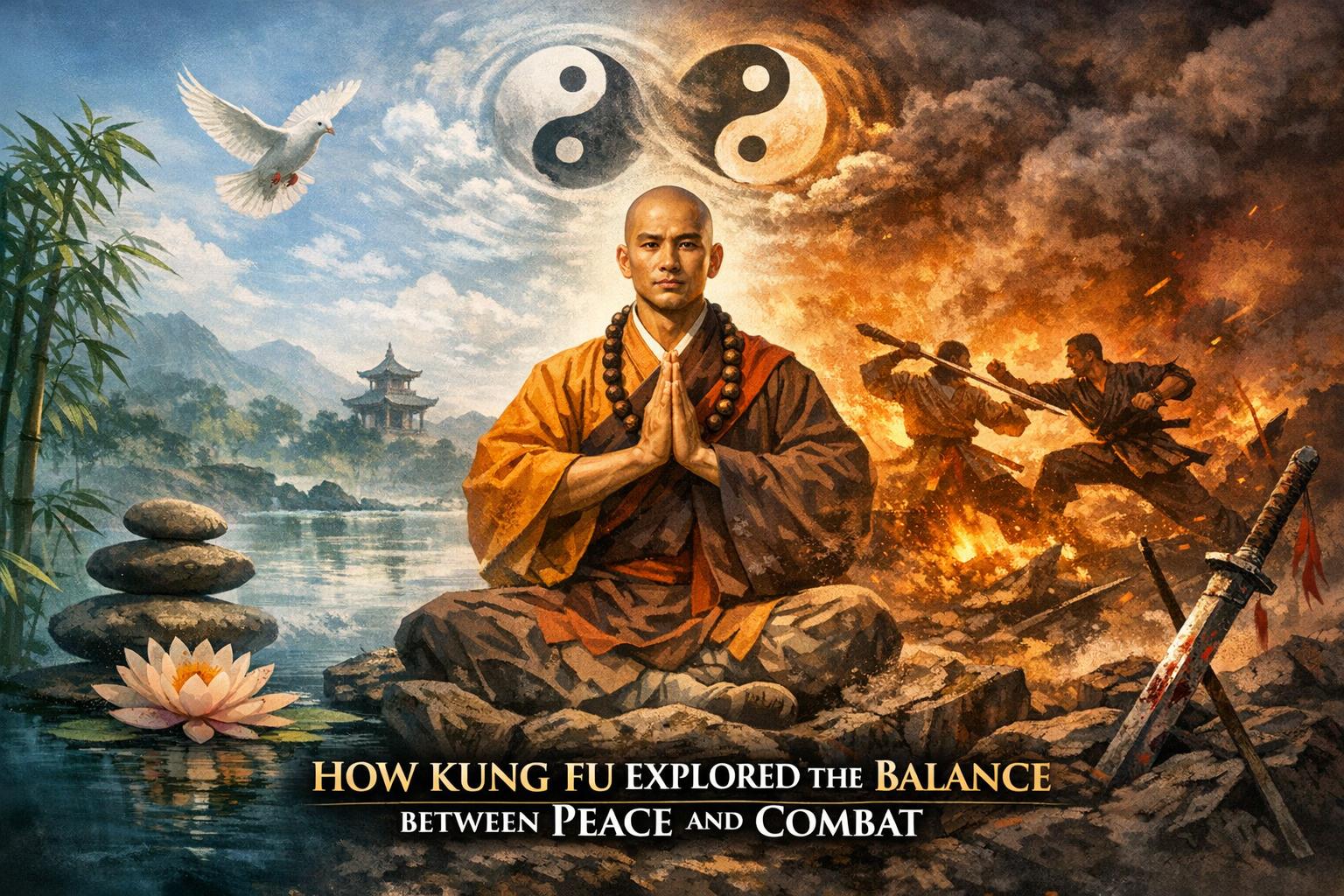
The Duality of Kung Fu: Peace and Combat
Kung Fu, often recognized as a collective term for traditional Chinese martial arts, encompasses far more than physical techniques for fighting. It represents a comprehensive system of self-cultivation in which physical discipline, philosophical reflection, and ethical conduct are interwoven. At its core lies a dynamic interplay between peace and combat. This duality defines the essence of Kung Fu: it is at once a method of self-defense and a disciplined path toward inner balance.
The apparent contradiction between cultivating peace and training for combat is not accidental. Instead, it reflects a deliberate philosophical structure developed over centuries. Kung Fu evolved in historical contexts where self-defense was necessary, yet its guiding principles were shaped by spiritual traditions that valued restraint, humility, and harmony. Rather than promoting violence, it frames combat as a last resort and emphasizes the responsibility that accompanies martial ability.
Philosophical Foundations
The philosophical foundations of Kung Fu are deeply influenced by Buddhist and Taoist thought. These traditions teach that human beings are part of a broader natural order and that imbalance, whether physical or emotional, leads to conflict. Accordingly, Kung Fu seeks to cultivate balance in both the practitioner’s body and mind.
Taoist philosophy introduces the principle of yin and yang, the complementary forces that shape existence. Softness and hardness, stillness and motion, receptivity and assertion are not opposites in conflict but interdependent aspects of a greater whole. In the context of martial practice, this means that yielding can overcome force and that flexibility often proves more effective than rigidity. A practitioner does not rely solely on muscular strength but learns to adapt, redirect, and harmonize with an opponent’s movement.
Buddhist influence adds an ethical dimension. Concepts such as mindfulness, compassion, and detachment from ego are integrated into training. The practitioner is encouraged to confront fear and aggression within the self before facing external challenges. Mastery of technique without mastery of intention is considered incomplete. Thus, the philosophical structure of Kung Fu places moral self-regulation alongside physical proficiency.
Training and Mental Discipline
Training in Kung Fu is rigorous and systematic. Physical conditioning includes stance work, flexibility exercises, strength development, and repetitive drilling of techniques. These elements develop endurance, coordination, and structural alignment. However, physical exertion is only one aspect of the process. Equal emphasis is placed on mental discipline.
Repetition plays a central role. Forms, sometimes referred to as sequences of choreographed movements, are practiced repeatedly to refine posture, timing, and breathing. This repetition is not mechanical. Each execution demands concentration and awareness of detail. Over time, practitioners cultivate the ability to remain focused under pressure. Distraction weakens technique; attention sustains it.
Breathing methods are integrated into movement to stabilize both the body and the mind. Controlled breathing regulates heart rate and supports efficient motion. This physiological regulation has psychological effects. When confronted with stress, a trained practitioner relies on disciplined breathing to maintain clarity. In this way, mental composure becomes inseparable from technical effectiveness.
Meditative practices are often embedded in training routines. Standing meditation, seated reflection, or slow-moving exercises foster self-awareness. These practices sharpen perception and encourage practitioners to observe their thoughts without immediate reaction. The objective is not to suppress emotion but to prevent impulsive responses. Through continuous practice, individuals learn to separate awareness from reaction, strengthening their capacity for measured action.
The Combat Aspect
Despite its emphasis on harmony, Kung Fu remains a martial discipline. Its techniques were developed for practical application in self-defense. Strikes, joint manipulations, throws, and defensive maneuvers are refined through partner drills and controlled sparring. Combat training involves learning distance management, timing, and reading an opponent’s intent.
The effectiveness of Kung Fu techniques depends on structural alignment and efficient use of energy. Rather than meeting force with force, many systems emphasize redirection. An incoming strike may be deflected while simultaneously creating an opening for counteraction. This principle reflects the broader philosophical idea that resistance is not always the optimal response to aggression.
Sparring and scenario-based practice introduce unpredictability. Practitioners must apply learned techniques in dynamic conditions. This stage of training bridges theory and application. However, restraint remains central. The objective is not domination but control. Students are taught that the highest level of skill may be demonstrated by resolving confrontation without escalating violence.
The combat dimension of Kung Fu also includes situational awareness. Practitioners develop attentiveness to surroundings and potential risks. Avoidance is regarded as preferable to engagement. Where withdrawal is possible and safe, it aligns with the principle of minimizing harm. In this framework, combat skills are tools of protection rather than instruments of aggression.
Integration of Mind and Body
Integration of mind and body is a defining characteristic of Kung Fu. Movements are not isolated muscular actions but expressions of coordinated intention. The practitioner learns to generate motion from the ground through stable stances and aligned posture. Each technique is supported by attentive awareness, connecting physical execution with deliberate thought.
Forms training illustrates this integration. Initially, students focus on memorizing sequences. Over time, attention shifts to subtler aspects: weight distribution, gaze direction, breath control, and internal sensation. Eventually, movement becomes fluid and intuitive. The body responds quickly, yet the mind remains calm. This state reflects the union of preparedness and composure.
The concept of flow emerges from this integration. When mind and body are synchronized, action occurs without hesitation. This condition is cultivated through consistent practice rather than sudden insight. The practitioner refines neural pathways and muscular coordination while reinforcing disciplined thought patterns. The result is responsiveness guided by awareness rather than instinctive aggression.
Ethics and Responsibility
Embedded within the practice of Kung Fu is a code of conduct. Respect for teachers, training partners, and oneself is emphasized from the earliest stages of instruction. Discipline extends beyond the training hall. Practitioners are expected to demonstrate integrity, patience, and self-control in daily life.
This ethical orientation mitigates the risks associated with martial proficiency. Knowledge of effective combat techniques carries responsibility. The practitioner is reminded that misuse of skill contradicts the philosophical foundation of the art. In many traditional schools, character development is regarded as equal in importance to technical advancement.
Humility is reinforced through continual learning. Advancement in rank or recognition does not signify completion. Even experienced practitioners revisit fundamental drills. This cyclical approach to improvement underscores that self-mastery is ongoing. The process fosters stability and reduces the likelihood of arrogance influencing behavior.
Historical Development and Cultural Context
Kung Fu developed across diverse regions of China, leading to a wide array of styles with varying techniques and training methods. Some systems emphasize external strength and dynamic movement, while others focus on subtle internal mechanics and energy cultivation. Despite stylistic differences, the underlying duality of peace and combat remains consistent.
Historically, martial arts were shaped by social conditions, regional conflicts, and the need for personal defense. At the same time, monasteries and philosophical communities contributed contemplative elements. The interaction of these influences resulted in a practice that addresses both survival and spiritual inquiry.
Cultural transmission has preserved rituals and etiquette that reinforce discipline. Bowing ceremonies, structured classes, and hierarchical teacher-student relationships reflect longstanding traditions. These practices provide continuity and contextual grounding, ensuring that training extends beyond physical technique.
The Lifelong Path of Practice
Engagement with Kung Fu is often described as a lifelong pursuit. Progress occurs gradually, with each stage revealing new challenges. Beginners may concentrate on coordination and stamina, while advanced practitioners refine internal structure and strategic awareness. Throughout this progression, the balance between peace and combat remains central.
Long-term practice tends to influence perception and behavior. The habit of measured breathing supports stress management. Familiarity with controlled confrontation reduces impulsive reactions. Physical conditioning contributes to general health and mobility. These effects demonstrate how the discipline extends beyond martial contexts.
The dual aspect of Kung Fu—embracing both peace and combat—gives the art its enduring relevance. It acknowledges the reality of conflict while promoting restraint and ethical awareness. Combat skills are cultivated not to encourage violence but to develop confidence and preparedness. Peace is not portrayed as passivity but as a deliberate state maintained through discipline.
In this synthesis of physical rigor and philosophical reflection, Kung Fu offers a structured method for personal development. Its techniques prepare individuals to protect themselves when necessary, while its principles guide them toward composure and balance. The art’s sustained appeal arises from this integration, demonstrating that the pursuit of martial competence and the cultivation of inner peace need not be opposing goals but complementary dimensions of a single practice.
This article was last updated on: April 7, 2026