

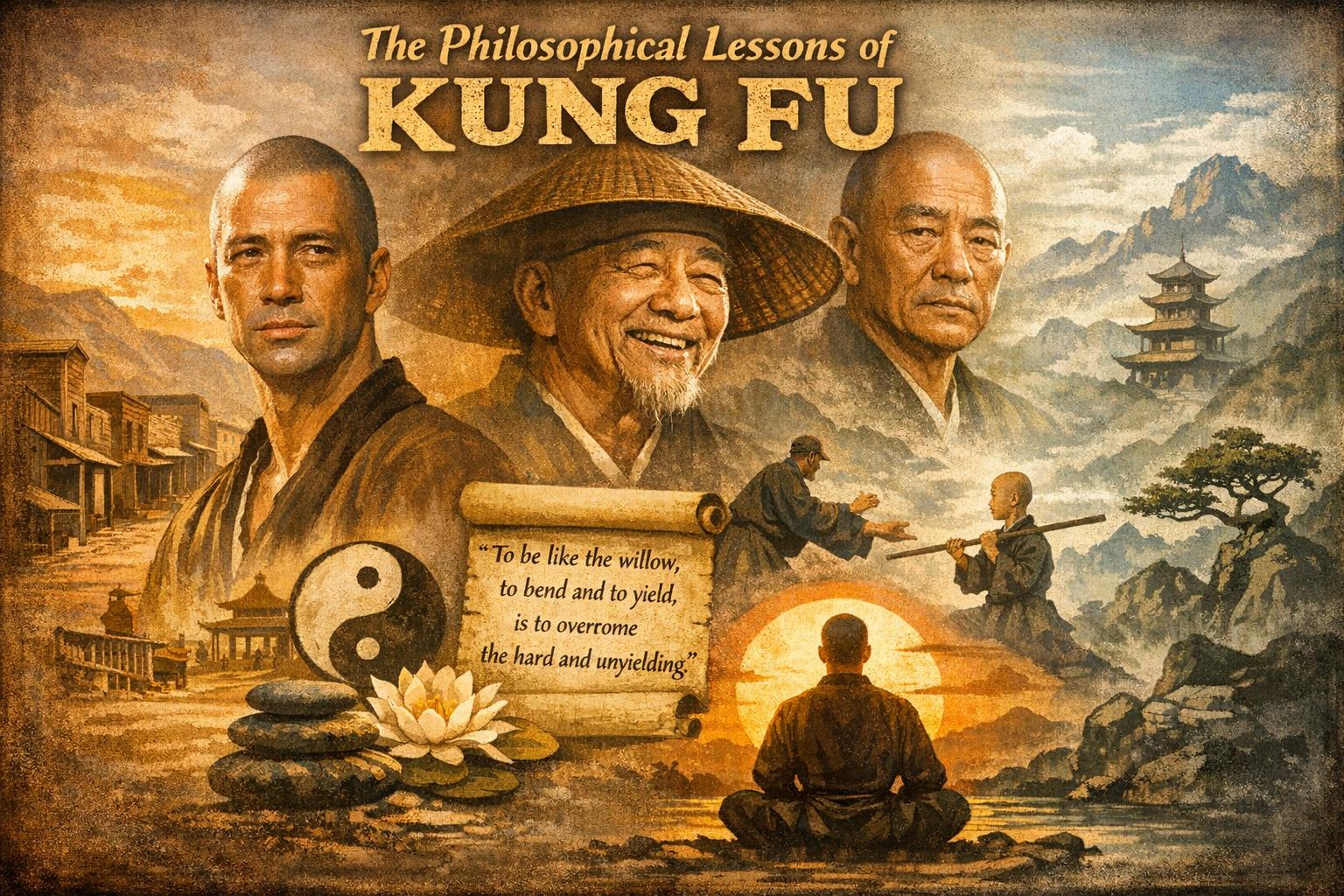
Introduction to the Philosophical Themes in Kung Fu
The television series Kung Fu, which aired from 1972 to 1975, occupies a distinctive place in the history of American popular culture. Set in the American Old West, the show follows the journey of Kwai Chang Caine, a Shaolin monk who travels across the frontier while evading bounty hunters. Although it contains elements of action and drama typical of its era, the series is structured around philosophical reflection rather than spectacle. Each episode presents a moral or contemplative problem that Caine addresses not only through physical skill, but through disciplined thought and ethical restraint.
The program introduced many Western viewers to simplified interpretations of Buddhist and Taoist ideas. While its presentation was adapted for a mainstream audience, the series consistently foregrounds themes such as self-mastery, detachment, compassion, and harmony. Through dialogue, flashbacks to the Shaolin temple, and Caine’s interactions with settlers, outlaws, and townspeople, the show frames martial arts as an expression of disciplined philosophy rather than aggression. In doing so, Kung Fu invites viewers to consider philosophical reflection as relevant to everyday conflicts.
The Foundation of Eastern Philosophy
The intellectual groundwork of the series draws heavily from Buddhism and Taoism, although it presents these traditions in a blended and accessible form. Buddhism contributes ideas of suffering, impermanence, and mindful awareness, while Taoism introduces the principle of alignment with the natural order, or the Tao. Together, these traditions provide the moral vocabulary through which Caine interprets the events around him.
In the narrative structure of the show, conflicts are rarely resolved through force alone. Instead, episodes are organized around a philosophical question: How should one respond to injustice? What is the proper relationship between strength and restraint? How does one remain centered amid chaos? Caine’s responses embody a fusion of introspection and action. His approach reflects the Buddhist emphasis on right intention and the Taoist ideal of wu wei, often translated as “non-forcing” or “effortless action.”
This philosophical framework distinguishes Kung Fu from many contemporary Western programs. Rather than framing the protagonist as a conventional hero who imposes order through dominance, the show presents a traveler who seeks to restore balance with minimal disruption. The emphasis falls not on victory, but on understanding and ethical alignment.
Meditation and Mindfulness
A recurring device in the series is the intercutting of present-day events with scenes from Caine’s training at the Shaolin temple. In moments of uncertainty, he recalls the measured guidance of his teachers, often delivered in concise parables. These recollections emphasize meditation as a method of cultivating insight rather than escaping reality.
Meditation in Kung Fu is not portrayed as an abstract ritual removed from daily life. Instead, it functions as practical preparation for action. Through stillness and focused breathing, Caine clarifies his thoughts and evaluates his motives. This reflects the Buddhist concept of mindfulness, defined as sustained attention to the present moment without excessive attachment or aversion. Episodes illustrate that rash decisions arise from uncontrolled emotion, whereas mindful awareness permits deliberate response.
The series implicitly teaches that reflection precedes effective action. When confronted by hostility, Caine often pauses before speaking or moving. This pause is not hesitation born of weakness, but an intentional space for evaluation. Such moments reinforce the idea that awareness itself is a form of strength. The discipline of meditation becomes a foundation for composure under pressure.
Balance and Harmony
Balance is perhaps the most persistent philosophical motif in the series. Influenced by Taoist thought, Kung Fu repeatedly asserts that opposing forces are interdependent rather than mutually exclusive. Strength coexists with gentleness; action complements stillness; justice is tempered by mercy. The visual symbolism of yin and yang, though not always explicitly named, informs the ethical landscape of the narrative.
Caine’s conduct illustrates that harmony does not imply passivity. Rather, it signifies proportion. When he engages in combat, his movements are controlled and economical. He does not pursue conflict unnecessarily, but neither does he avoid it when necessary to protect others. This approach mirrors the Taoist proposition that effective action aligns with circumstances rather than resisting them blindly.
The Western frontier setting, often depicted as chaotic and violent, provides a contrasting backdrop against which harmony becomes meaningful. In towns characterized by greed or prejudice, Caine’s measured behavior demonstrates an alternative mode of existence. By neither dominating nor submitting unjustly, he maintains internal equilibrium. The underlying suggestion is that balance begins within the individual before it shapes external relations.
Non-Violence and Compassion
Although martial arts are central to the identity of the protagonist, the series consistently frames physical combat as a last resort. This reflects the Buddhist principle of ahimsa, or non-harm. Caine attempts dialogue and negotiation before engaging in confrontation. Even when he must defend himself or others, his objective is restraint rather than punishment.
Compassion in Kung Fu extends beyond sympathy. It involves recognition of shared vulnerability, including in adversaries. Several episodes depict Caine sparing opponents or offering guidance after conflict. Such actions reinforce the premise that moral authority derives from self-control. The program thereby challenges the notion that dominance proves superiority. Instead, it proposes that compassion signals maturity.
This orientation toward non-violence does not eliminate tension from the narrative. On the contrary, ethical restraint often complicates situations. Caine’s refusal to retaliate impulsively may expose him to risk. Yet the series consistently suggests that adherence to principle outweighs temporary advantage. Physical skill becomes subordinate to moral intention.
The Role of Wisdom and Learning
Wisdom in Kung Fu is portrayed as cumulative and experiential. Caine’s abilities are not innate talents but the result of disciplined study under experienced mentors. The emphasis on lifelong learning challenges the idea of mastery as a fixed achievement. Instead, mastery appears as an ongoing process of refinement.
The narrative structure reinforces this theme by juxtaposing youthful training scenes with adult application. The lessons imparted in the temple are tested in unpredictable frontier environments. Through this contrast, the series demonstrates that knowledge gains meaning through application. Teaching without practice becomes abstraction, while practice without reflection loses direction.
Furthermore, humility is depicted as essential to growth. Caine rarely claims superiority, even when his abilities exceed those around him. This humility reflects a broader philosophical stance: wisdom is not accumulation of status, but awareness of limitations. By acknowledging uncertainty, the individual remains receptive to learning.
Mentorship and Guidance
The dynamic between teacher and student forms one of the central narrative engines of the series. Masters at the Shaolin temple, particularly Master Po and Master Kan, provide concise instruction that blends practical discipline with metaphor. Their guidance illustrates an educational model grounded in dialogue rather than authoritarian command.
Mentorship in this context is reciprocal. While teachers provide knowledge, students contribute attentiveness and sincerity. The respect between generations reflects Confucian influences as well, where filial respect and social harmony reinforce moral development. Through these interactions, Kung Fu frames education as moral cultivation rather than technical training alone.
Flashbacks serve as reminders that present decisions rest upon earlier foundations. Caine’s recollections demonstrate that ethical guidance, once internalized, operates independently of the teacher’s physical presence. This narrative device underscores continuity between past and present learning, suggesting that instruction becomes part of character.
The Importance of Questioning
Despite the reverence shown toward teachers, the series does not portray wisdom as unquestioned authority. Young Caine frequently asks probing questions about suffering, justice, and fear. His instructors respond with parables or counterquestions, encouraging contemplation instead of providing rigid answers. This pedagogical method aligns with both Buddhist and Taoist traditions, where insight arises from reflection rather than doctrinal assertion.
In the frontier setting, Caine continues this pattern of inquiry. He challenges assumptions rooted in prejudice, particularly racial and cultural biases directed at him. Rather than confront hostility with hostility, he invites reconsideration. Questioning thus becomes a method of diffusing tension and prompting ethical reflection in others.
The show presents curiosity as compatible with discipline. Far from undermining authority, thoughtful questioning deepens understanding. By modeling this approach, Kung Fu portrays intellectual openness as integral to moral strength.
Cultural Translation and Adaptation
An important dimension of the series lies in its role as cultural intermediary. Produced for an American audience, Kung Fu adapts complex Eastern philosophies into concise narratives. Inevitably, this adaptation simplifies doctrines and merges distinct traditions. Nevertheless, it introduces concepts rarely depicted in mainstream Western television at the time.
The program situates Asian philosophical principles within the framework of the American Western genre. This blending creates productive tension. The frontier, associated with expansion and confrontation, contrasts with ideals of detachment and non-contention. Through this juxtaposition, the show suggests that philosophical insight is not confined to monasteries but applicable within diverse cultural settings.
At the same time, contemporary viewers and critics have examined questions of representation and authenticity. The casting of a non-Asian lead actor in the role of a Chinese monk generated discussion about cultural portrayal. Regardless of such controversies, the series contributed to broader awareness of martial arts and contemplative traditions in Western societies.
Ethics in Action: Practical Philosophy
What distinguishes Kung Fu from purely didactic programming is its insistence that philosophical principles must operate in concrete situations. Moral dilemmas in the series involve property disputes, racial prejudice, corruption, and personal vengeance. Caine’s responses illustrate the translation of abstract ideals into practical conduct.
The concept of right action, central to Buddhist ethics, manifests in careful evaluation of consequences. Rather than pursuing personal gain, Caine assesses how choices affect the broader community. Episodes often conclude not with punishment but with restoration of order. This pattern supports the thesis that ethical consistency gradually reshapes environments.
Moreover, the show underscores the relationship between inner discipline and social stability. Where individuals act impulsively, disorder follows. Where individuals cultivate self-control, stability emerges. Although dramatized within fictional narratives, this principle carries broader philosophical implications about governance and responsibility.
Enduring Relevance
Decades after its original broadcast, Kung Fu remains a reference point in discussions of philosophy in popular media. Its integration of contemplative thought into episodic storytelling demonstrates that entertainment can engage substantive ideas without abandoning narrative momentum. Contemporary audiences, familiar with global exchanges of culture, may view its interpretations as introductory rather than comprehensive. Nonetheless, the central themes retain relevance.
Mindfulness has entered mainstream discourse in psychology and education. Concepts of balance and non-reactivity inform conflict resolution and leadership studies. The portrayal of mentorship continues to resonate in professional and academic contexts. In this regard, the series anticipated later interest in integrating contemplative practices into secular environments.
Conclusion
Kung Fu presents a model of storytelling in which action and reflection coexist. Through the character of Kwai Chang Caine, the series introduces audiences to foundational ideas derived from Buddhism and Taoism, including mindfulness, balance, non-violence, humility, and the pursuit of wisdom. These themes are not treated as abstract doctrines but as guides for navigating conflict and uncertainty.
By embedding philosophical dialogue within the familiar structure of the Western genre, the show creates a sustained meditation on ethical conduct. Its portrayal of disciplined restraint challenges assumptions about heroism and strength. Wisdom, as depicted in the series, arises from continuous learning, respectful mentorship, and the courage to question.
The enduring significance of Kung Fu lies in its demonstration that philosophy can operate within everyday life. Through measured action and reflective thought, the series suggests that harmony is not an unattainable ideal but a practical objective shaped by individual choices. In presenting this perspective, the program contributes a distinctive chapter to the intersection of television narrative and philosophical inquiry.
This article was last updated on: March 17, 2026