

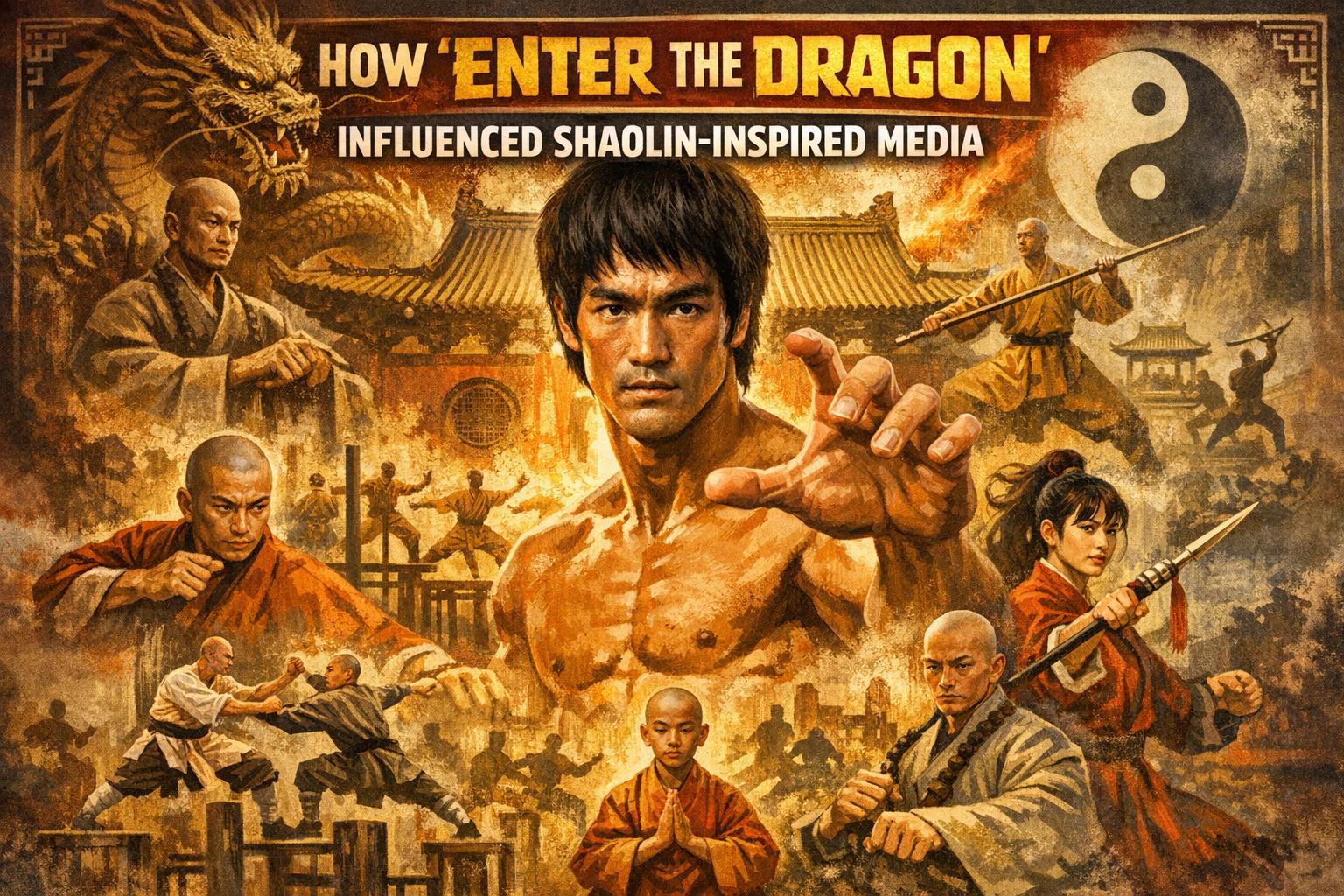
Introduction to Enter the Dragon
Released in 1973, Enter the Dragon marked a significant turning point in the global development of martial arts cinema. Produced through a collaboration between Golden Harvest and Warner Bros., the film was among the first major co-productions between Hong Kong and Hollywood studios. Its commercial success demonstrated that martial arts films could reach a worldwide audience and generate substantial box office returns outside Asia. More importantly, it standardized many of the visual and thematic conventions that would define martial arts media for decades.
The film centers on a Shaolin-trained martial artist recruited to infiltrate a private martial arts tournament organized by a criminal mastermind. The narrative structure combines espionage elements with tournament-style combat, offering a framework that allowed martial arts sequences to be integrated into a broader cinematic format familiar to Western viewers. Within this structure, the depiction of Shaolin discipline, training, and philosophy played a critical role in shaping international perceptions of Chinese martial traditions.
Bruce Lee’s Legacy
Bruce Lee’s performance in Enter the Dragon established him as an international cultural figure. Although he had already achieved recognition in Hong Kong cinema and through earlier productions such as The Big Boss and Fist of Fury, this film positioned him for global visibility. His on-screen presence combined technical precision, athleticism, and philosophical articulation. This combination presented martial arts not merely as physical combat, but as a disciplined system rooted in self-knowledge and efficiency.
Lee’s training background included Wing Chun, Western boxing, fencing concepts, and personal innovations that he later formalized into Jeet Kune Do. Despite this eclectic foundation, the film framed his character as a product of Shaolin training. Early scenes referencing the Shaolin Temple connected Lee’s performance to a broader historical and spiritual narrative associated with Chinese martial heritage. This portrayal reinforced the idea that Shaolin Kung Fu represented both a fighting system and a disciplined way of life.
Beyond cinematic performance, Lee’s writings and interviews emphasized adaptability, directness, and the rejection of rigid stylistic boundaries. However, popular media often interpreted his teachings through a simplified lens, associating them with a generalized image of Shaolin wisdom. As a result, Lee’s legacy contributed to a global perception of Shaolin arts as practical, efficient, and philosophically grounded.
Representation of Martial Authenticity
One distinguishing feature of Enter the Dragon was its relative emphasis on functional technique rather than exaggerated choreography. While later martial arts cinema often incorporated elaborate wirework and highly stylized movements, this film presented combat with a focus on speed, timing, and impact. Lee’s physical conditioning and precise execution created an impression of authenticity that resonated with audiences unfamiliar with traditional Chinese martial systems.
This approach influenced subsequent filmmakers who sought to replicate the perceived realism of Lee’s performance. Training montages, disciplined sparring sequences, and minimalistic fight choreography became common features. In many cases, filmmakers directly referenced Lee’s fighting stance, facial composure, or rhythmic footwork when constructing Shaolin-inspired characters.
Cross-Cultural Impact
The film’s production context also contributed to its significance. By integrating Western cinematic techniques with Hong Kong fight choreography, Enter the Dragon created a template for international collaboration. Dialogue in English expanded accessibility, while the tournament setting provided a neutral narrative device that allowed characters from multiple cultural backgrounds to interact.
This cross-cultural framework reinforced the universal appeal of martial arts themes. Concepts such as honor, discipline, training, and personal mastery transcended linguistic barriers. As a result, the image of Shaolin-influenced martial arts entered mainstream entertainment markets in North America, Europe, and beyond.
Increased Interest in Martial Arts
Following the film’s international success, martial arts schools experienced measurable growth in enrollment. In the United States and Western Europe, new academies opened to meet public demand. Although not all of these schools taught authentic Shaolin systems, many adopted Shaolin terminology, imagery, or philosophical references in their promotional materials.
This surge in popularity influenced publishing, broadcasting, and consumer goods industries. Instructional manuals on kung fu techniques and Eastern philosophy appeared in bookstores. Magazines featured articles explaining Shaolin history, temple legends, and training regimens. Television programs began incorporating martial arts demonstrations and interviews with instructors.
The increased visibility also affected Asian diaspora communities. Martial arts became a means of cultural representation, allowing heritage traditions to enter public awareness in societies where they had previously been marginalized or misunderstood. The Shaolin Temple, in particular, became a widely recognized symbol of Chinese martial heritage.
Shaolin as a Cultural Reference
Before the 1970s, knowledge of Shaolin traditions outside Asia was limited. Enter the Dragon contributed to a broader mythologizing of the Shaolin Temple as a source of disciplined warriors and spiritual insight. Although the film itself includes only brief references to temple life, these references were sufficient to establish a cultural template that other productions expanded upon.
Subsequent films, television series, and comic adaptations portrayed Shaolin monks engaged in demanding physical training, meditation, and strict moral codes. The association between Shaolin practice and ethical restraint became a recurring theme. In many narratives, a Shaolin-trained character demonstrated superior moral judgment alongside physical capability, reinforcing a dual image of strength and restraint.
These portrayals, while often simplified, shaped public understanding. In Western popular culture, the term “Shaolin” gradually evolved into shorthand for disciplined martial excellence. Even productions with limited historical accuracy adopted the aesthetic markers introduced or popularized during the post-1973 era.
Hollywood’s Adoption of Shaolin Elements
Hollywood’s response to the success of Enter the Dragon was pragmatic. Studios recognized the commercial viability of martial arts content and began integrating Shaolin-inspired sequences into action films. From the mid-1970s onward, numerous productions featured training scenes set in temple-like environments, instructors modeled after monastic archetypes, and protagonists drawing on Eastern philosophical aphorisms.
Television programs introduced wandering monk characters or martial arts mentors who guided younger protagonists. Animated series and comic books incorporated Shaolin motifs, presenting monasteries as hidden repositories of secret techniques. Video games emerging in the 1980s and 1990s further embedded these themes, allowing players to control monk-like fighters or tournament champions reminiscent of Lee’s character.
While not all of these adaptations were historically grounded, they demonstrate the diffusion of Shaolin imagery across entertainment media. This diffusion can be traced back, in significant measure, to the commercial and cultural impact of Enter the Dragon.
Further Influence in Media
The narrative structure of Enter the Dragon introduced a model that proved highly adaptable: a disciplined martial artist entering a competitive arena controlled by a powerful antagonist. This format has been replicated across genres. Tournament-centered storytelling appears in numerous martial arts films, as well as in science fiction, fantasy, and digital gaming narratives.
Beyond structure, the integration of philosophical dialogue into action cinema became a distinguishing characteristic. Lee’s conversations regarding awareness, emotional control, and adaptability provided moments of reflection amid combat sequences. Later filmmakers adopted similar techniques, inserting concise statements about discipline or self-knowledge into high-action scripts.
The blending of philosophical commentary with physical confrontation created a multidimensional protagonist. Rather than presenting fighters solely as physical instruments, these narratives framed them as individuals guided by principles. This approach allowed martial arts films to address broader themes such as identity, loyalty, and restraint without abandoning commercial appeal.
Evolution of the Martial Arts Protagonist
Prior to the early 1970s, many Western action heroes relied primarily on firearms or brute force. After the international reception of Enter the Dragon, studios began exploring protagonists defined by technical skill and controlled physical performance. Martial arts became a credible alternative to conventional action tropes.
Actors who followed in Lee’s path often trained extensively to achieve authenticity. Choreographers refined fight sequences to emphasize clarity of movement and rhythm. In many cases, characters were explicitly described as having trained in Shaolin or derivative systems. Even when fictionalized, such references lent perceived legitimacy to the narrative.
This evolution contributed to a sustained market for martial arts-themed films throughout the 1980s and 1990s. International stars emerged, each drawing partly on the model established by Lee’s portrayal.
Shaolin in Modern Entertainment
The legacy of Enter the Dragon is visible in contemporary cinema and streaming productions. Modern films frequently include visual cues associated with Shaolin tradition: structured group training, wooden dummies, disciplined formations, and temple architecture. Although production budgets and visual effects have expanded significantly, these foundational motifs remain recognizable.
Documentary projects focusing on the modern Shaolin Temple have also benefited indirectly from the film’s earlier popularization. Audiences possess a preexisting frame of reference that associates Shaolin with martial expertise. This familiarity supports continued interest in historical and contemporary explorations of the temple’s role.
In digital entertainment, martial arts-based video games continue to employ tournament scenarios, disciplined monk characters, and philosophical narratives about balance and mastery. These elements align closely with the template popularized in 1973.
Institutional and Cultural Consequences
The film’s influence extended to institutional developments within martial arts communities. International tournaments and exhibitions increased in frequency. Demonstration teams conducted global tours, often referencing the cinematic popularity that had heightened audience interest.
Academic discussions of martial arts as cultural practice also expanded during the decades following the film’s release. Scholars examined the relationship between diaspora identity, cinematic representation, and transnational exchange. In this context, Enter the Dragon often appears as a case study in how a single production can reshape global cultural awareness of a traditional practice.
Conclusion
Enter the Dragon occupies a central position in the history of martial arts media. Its commercial achievement demonstrated the viability of cross-cultural filmmaking, while its portrayal of Shaolin-influenced martial discipline shaped decades of storytelling conventions. Through Bruce Lee’s performance, audiences encountered a representation of combat that balanced physical efficiency with philosophical reference.
The film contributed to a sustained increase in interest in martial arts training, particularly within Western societies. It also established Shaolin imagery as a standard element of international entertainment, influencing film, television, print media, and interactive platforms. Although later productions diversified and stylized these elements, the foundational model remains identifiable.
More than five decades after its release, the structural and thematic features introduced in Enter the Dragon continue to inform portrayals of Shaolin traditions. Its role in transforming martial arts from a regional genre into a global cultural form ensures its ongoing relevance within discussions of cinema history and media development.
This article was last updated on: March 10, 2026