

Introduction
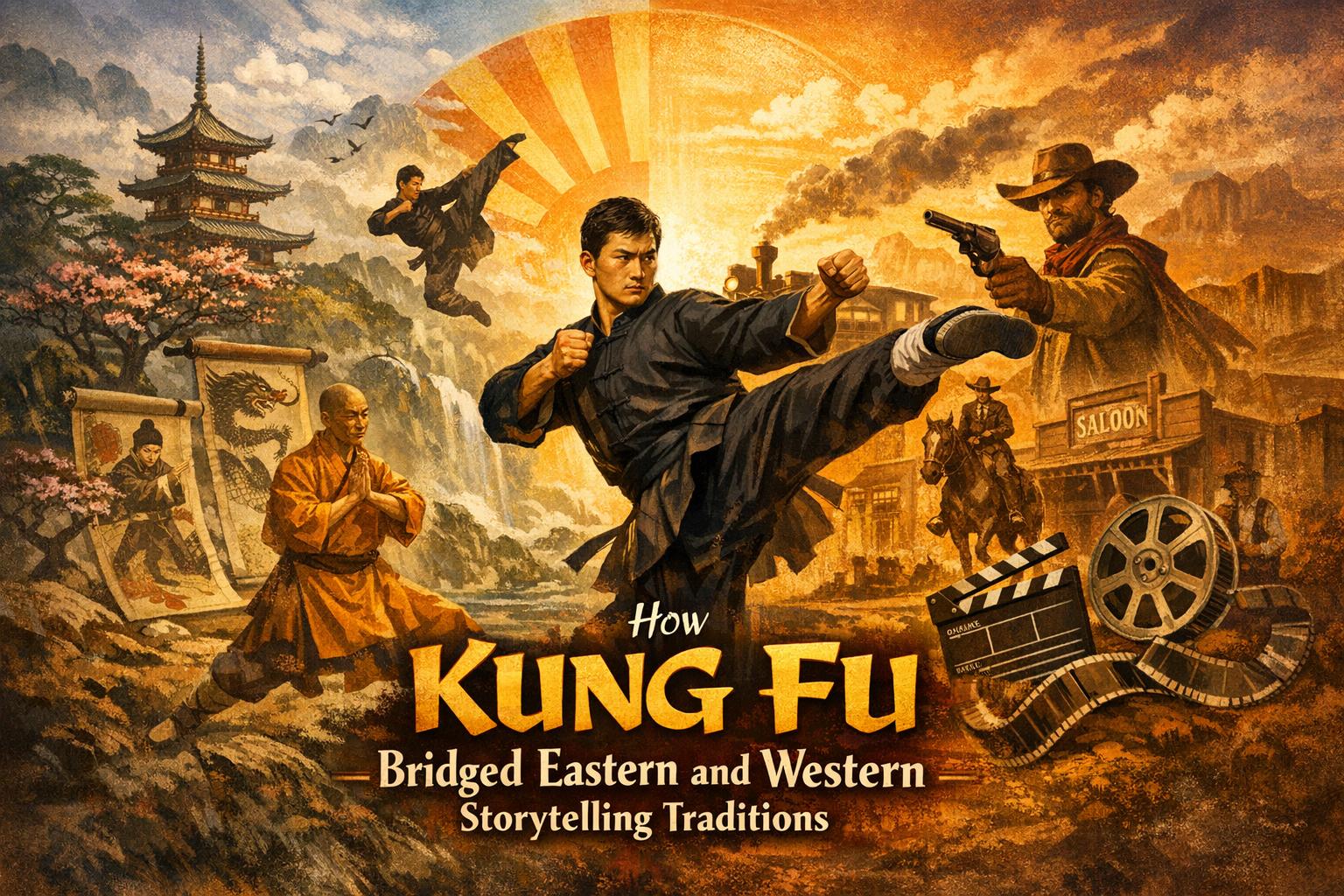
Kung Fu, a martial art form deeply rooted in Chinese civilization, represents more than organized systems of combat. Over centuries, it has functioned as a cultural practice integrating philosophy, ethics, medicine, performance, and narrative. As global communication expanded during the twentieth century, Kung Fu became one of the most visible cultural exports of China, particularly through cinema and literature. In this context, it evolved into a narrative device capable of bridging Eastern and Western storytelling traditions. Through its movement vocabulary, philosophical underpinnings, and archetypal characters, Kung Fu provided Western audiences with new narrative structures while also influencing Chinese storytellers to adapt elements of Western dramaturgy.
The spread of Kung Fu stories across borders fostered a sustained process of intercultural exchange. Rather than functioning as a static tradition, Kung Fu narratives adapted to new audiences, production models, and artistic conventions. This evolution reflects how storytelling traditions respond to global circulation while retaining distinctive cultural features. By examining the historical emergence of Kung Fu in storytelling, its cinematic transformations, its literary influence, and its role in cultural dialogue, one can better understand its significance within contemporary global narrative forms.
Historical Emergence of Kung Fu in Storytelling
The origins of Kung Fu lie in varied martial practices developed across different regions of China. While the term “Kung Fu” broadly denotes skill acquired through discipline and effort, popular usage refers to Chinese martial arts systems. These systems were shaped by military training, regional defense needs, religious institutions such as the Shaolin Temple, and philosophical frameworks including Confucianism, Taoism, and Buddhism. From early periods, martial practice was associated not only with combat effectiveness but also with moral cultivation and self-regulation.
Traditional Chinese storytelling integrated martial arts into oral narratives, theatrical performances, and later written fiction. Classical novels such as Water Margin and Romance of the Three Kingdoms incorporated martial heroes whose fighting skills were inseparable from questions of loyalty, justice, and social order. Later, the wuxia genre systematized martial arts storytelling. In wuxia narratives, protagonists operate within a semi-historical world known as the jianghu, a social sphere separate from official institutions. This narrative space enabled exploration of ethical dilemmas outside rigid political hierarchies. Martial arts techniques in these stories functioned symbolically, representing moral refinement, discipline, and the pursuit of harmony.
The philosophical foundations of Kung Fu strongly influenced narrative structure. Taoist concepts of balance and cyclical change encouraged storytelling patterns that emphasized transformation rather than simple linear progression. Buddhist themes of enlightenment and detachment underscored narratives in which external combat paralleled internal struggle. Confucian ideals reinforced the importance of hierarchical relationships, mentorship, and filial responsibility. As a result, early Kung Fu narratives frequently centered on apprenticeship, betrayal, self-cultivation, and the restoration of social equilibrium.
The twentieth century marked a significant turning point in the international reception of Kung Fu. Political upheaval in China, migration patterns, and expanding film industries in Hong Kong and Taiwan facilitated the production and export of martial arts films. The global prominence of Bruce Lee during the late 1960s and early 1970s proved decisive. Lee’s films presented a version of Kung Fu that combined Asian philosophical references with production techniques accessible to Western audiences. His on-screen personas emphasized discipline, rationality, and resistance to injustice, qualities that resonated beyond cultural boundaries.
Bruce Lee’s articulation of martial arts as a flexible philosophy, rather than a rigid tradition, also supported cross-cultural interpretation. He openly critiqued stylistic dogmatism and advocated personal adaptation. This framing allowed Western audiences to interpret Kung Fu not merely as an exotic spectacle but as a system of thought compatible with broader human concerns. Consequently, Kung Fu transitioned from a regional narrative tradition into a global storytelling framework.
Kung Fu in Cinema
Cinema provided the most visible platform for the blending of Eastern and Western storytelling through Kung Fu. Early Hong Kong martial arts films drew upon established wuxia conventions, including themes of loyalty, revenge, honor, and clan conflict. These films often presented episodic structures, emphasizing training sequences, confrontations, and moral reflection. Characterization focused on archetypal roles such as the righteous hero, corrupt official, or treacherous rival.
Western narrative cinema, particularly in Hollywood, traditionally prioritized linear cause-and-effect plotting, psychological character development, and clear narrative closure. When Kung Fu entered Western film markets, filmmakers began experimenting with hybrid forms. Rather than replacing Western conventions, Kung Fu elements were integrated into established genres such as action, drama, and even comedy.
Ang Lee’s Crouching Tiger, Hidden Dragon illustrates this convergence. Rooted in wuxia literature, the film incorporates stylized combat and an emphasis on honor and restraint. However, it also employs character-driven storytelling familiar to Western audiences, exploring personal longing, generational conflict, and limited social mobility. The pacing alternates between contemplative sequences and choreographed action, blending philosophical reflection with cinematic spectacle.
Quentin Tarantino’s Kill Bill demonstrates a different form of integration. Drawing consciously on Hong Kong martial arts cinema, Japanese samurai films, and Western revenge narratives, the film constructs a layered homage to multiple traditions. The structure remains largely linear, yet stylistic elements such as exaggerated fight choreography and thematic emphasis on disciplined mastery reveal the influence of Kung Fu storytelling. In this case, Eastern motifs become components within a broader postmodern cinematic language.
Choreography itself functions as narrative expression. In many Kung Fu films, fight sequences are not interruptions of plot but extensions of it. Movement communicates psychological states, ideological positions, and relational dynamics. A controlled and minimal style may signify inner balance, while chaotic movement may signal emotional instability. Western action cinema increasingly adopted this principle, placing greater emphasis on the visual clarity and symbolic resonance of staged combat.
Training sequences further represent a shared narrative mechanism. In traditional Kung Fu films, prolonged depictions of practice underscore the value of perseverance and moral discipline. Western adaptations integrated similar montages to signal character transformation. However, Western films often condense training into abbreviated sequences, reflecting different pacing expectations. The contrast highlights the negotiation between narrative tempo and thematic emphasis during cross-cultural adaptation.
In addition to filmmaking techniques, production collaboration contributed to stylistic fusion. Co-productions between Chinese and Western studios facilitated the exchange of choreographers, cinematographers, and writers. This institutional cooperation reinforced the role of Kung Fu as a transnational narrative resource rather than a culturally isolated genre.
Literary Influence
While cinema accelerated the global visibility of Kung Fu, literature also absorbed and reinterpreted martial arts themes. The translation of wuxia novels into English and other European languages expanded access to foundational narratives. Writers outside China encountered alternative storytelling frameworks in which ethical reflection and physical discipline were inseparable.
In Western literature, martial arts themes frequently appear within fantasy, science fiction, and coming-of-age narratives. Authors adopt elements such as master-disciple relationships, hidden schools, or structured systems of skill progression. These components mirror wuxia traditions while adapting to Western genre conventions. For example, fantasy literature often depicts protagonists who undergo rigorous training to master specialized abilities, paralleling Kung Fu apprenticeships.
The concept of self-cultivation serves as a central bridge between traditions. In many Kung Fu narratives, martial mastery requires ethical refinement and introspection. Western literary adaptations sometimes reinterpret this process through secular frameworks, emphasizing psychological growth or resilience. Although philosophical terminology may differ, the structural role of disciplined development remains comparable.
Reciprocally, contemporary Chinese writers have incorporated Western narrative devices into martial arts fiction. Greater attention to internal monologue, complex romantic subplots, and nonlinear perspectives reflects exposure to global literary techniques. The result is not the erosion of traditional forms but their expansion. Hybrid novels combine wuxia world-building with narrative experimentation influenced by Western modernism and postmodernism.
Graphic novels and illustrated storytelling further highlight the mutual influence. Visual representations of martial arts techniques provide dynamic storytelling opportunities. Western creators drawing from Kung Fu aesthetics often emphasize expressive line work and kinetic energy inspired by Hong Kong cinema. Meanwhile, Chinese artists incorporate Western panel structures and narrative pacing. These visual narratives demonstrate how Kung Fu operates across media boundaries while retaining recognizable motifs.
Cultural Exchange and Mutual Influence
The integration of Kung Fu into Western storytelling cannot be understood solely as cultural exportation. It represents a multidirectional exchange shaped by migration, commerce, and artistic collaboration. Diasporic communities played a significant role in introducing martial arts schools and film screenings to Western cities. These localized interactions established social contexts in which storytelling traditions could be transmitted informally.
The global popularity of martial arts prompted Western institutions to develop training academies and research programs examining Asian philosophy and performance practice. Academic engagement further legitimized Kung Fu narratives as subjects of literary and cultural analysis. Through scholarly discourse, concepts embedded in martial arts storytelling—such as harmony, balance, and ethical conduct—entered comparative studies alongside Western philosophical frameworks.
Simultaneously, economic globalization influenced narrative production. International markets encouraged filmmakers and publishers to adapt content for diverse audiences. Subtitles, dubbing, and revised scripts altered dialogue and pacing. These modifications occasionally simplified cultural references, yet they also made stories accessible across linguistic boundaries. Over time, audiences became more receptive to culturally specific details, reducing the need for extensive modification.
Mutual influence is also evident in character construction. Western action heroes historically emphasized individualism and autonomy. By contrast, traditional Kung Fu protagonists often operate within networks of teachers, peers, and familial obligations. Hybrid narratives increasingly balance these models, presenting characters who combine personal agency with social responsibility. This synthesis reflects evolving global values regarding identity and community.
The thematic scope of Kung Fu stories has likewise broadened. Contemporary films and novels address urbanization, technological change, and cross-border conflict while retaining martial arts frameworks. Such narratives demonstrate that Kung Fu is adaptable to modern settings without losing its symbolic function. Western creators contribute perspectives shaped by different social contexts, further diversifying narrative possibilities.
Media convergence continues to accelerate the exchange process. Streaming platforms distribute martial arts series to international viewers almost simultaneously. Video games incorporate combat systems inspired by Kung Fu choreography, enabling interactive storytelling. These developments illustrate how martial arts function as narrative architecture across digital platforms.
Importantly, the cross-cultural adaptation of Kung Fu also raises questions of representation and authenticity. Filmmakers and authors navigate the balance between homage and appropriation. Increased collaboration with cultural consultants, historians, and choreographers reflects awareness of these concerns. Rather than a unidirectional borrowing process, contemporary storytelling often involves negotiated participation among creators from multiple backgrounds.
The enduring global presence of Kung Fu underscores its structural flexibility. At its core, it offers a framework for representing conflict, growth, and moral inquiry. Whether situated in historical China, modern urban centers, or speculative futures, the martial arts narrative model accommodates diverse settings. The emphasis on disciplined practice provides an internal logic for character transformation, while choreographed confrontation supplies visual and dramatic momentum.
Over decades of exchange, Eastern and Western storytelling traditions have influenced one another in ways that extend beyond martial arts. The success of Kung Fu narratives demonstrated the viability of cross-cultural genre integration. Filmmakers and writers now routinely blend mythological motifs, narrative pacing styles, and character archetypes from multiple cultural sources. In this broader context, Kung Fu serves as one of the earliest and most sustained examples of global narrative hybridity.
As Kung Fu continues to circulate across media and regions, it remains an active participant in shaping contemporary storytelling. Its philosophical foundations invite reflection on discipline and balance, while its performative elements provide adaptable tools for dramatizing struggle and transformation. Through sustained cultural dialogue, Kung Fu has contributed to a storytelling tradition that recognizes both difference and shared human concerns, reinforcing its relevance in an interconnected world.
This article was last updated on: June 16, 2026