

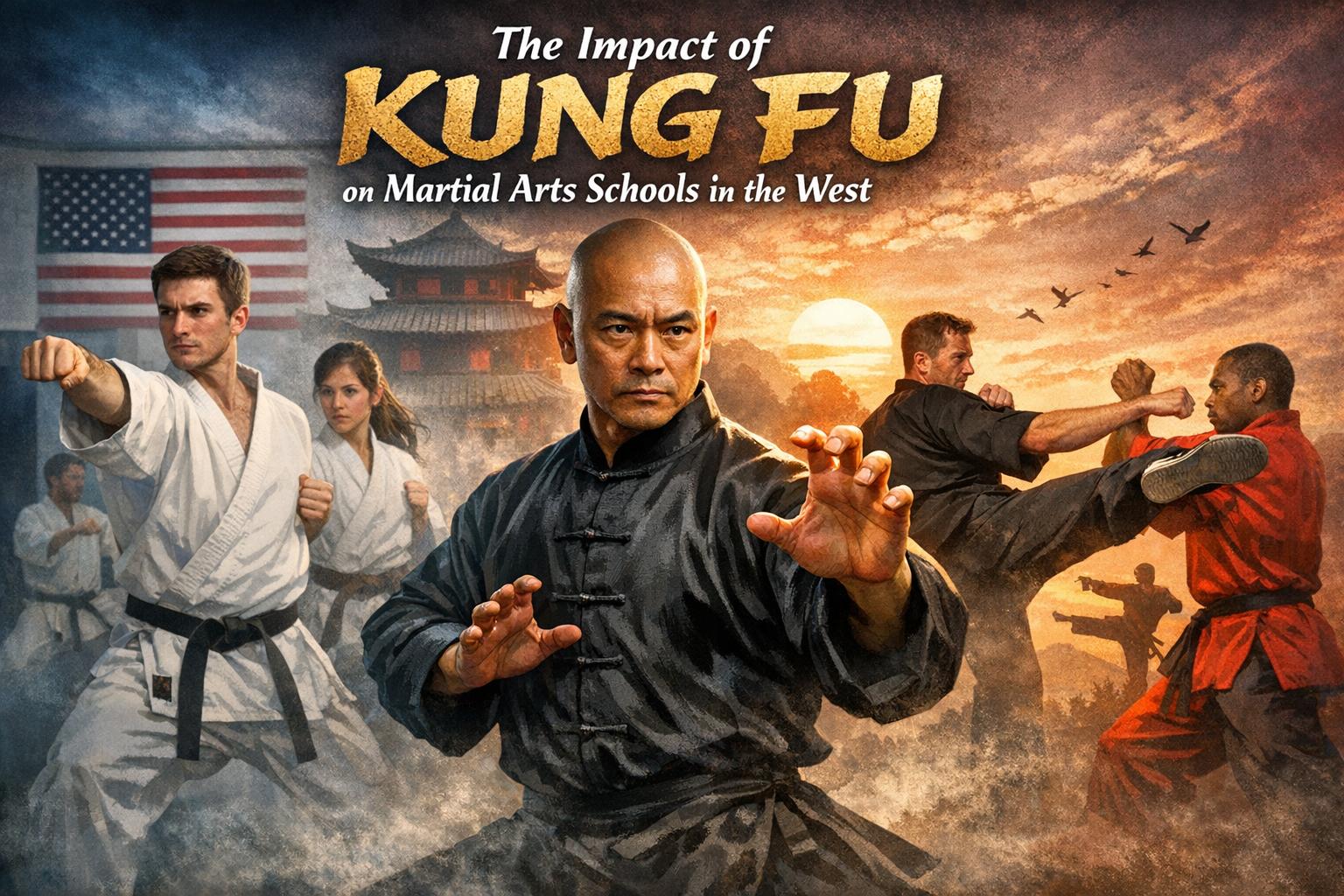
The Introduction of Kung Fu to the Western World
Kung Fu, a broad term referring to a wide range of Chinese martial art systems, entered Western consciousness through a gradual process of migration, cultural exchange, and popular media representation. Although Chinese communities had practiced martial traditions abroad since the nineteenth century, widespread Western awareness did not develop until the twentieth century. Early Chinese immigrants established small training halls in cities such as San Francisco, New York, and Vancouver, where instruction was often limited to members of local Chinese communities. These early schools maintained traditional teaching models, emphasizing loyalty, structured progression, and preservation of lineage.
The global political climate of the mid-twentieth century influenced the spread of Kung Fu beyond these communities. Increased migration after changes in immigration policies allowed experienced practitioners to establish schools that accepted students from diverse backgrounds. At the same time, the expansion of international trade and communication created new opportunities for cultural exchange. Demonstrations, exhibitions, and public performances introduced Western audiences to structured forms, weapons routines, and partner drills that differed from familiar boxing or wrestling practices.
The decisive shift in public interest, however, came through cinema and television. Martial arts films of the 1960s and 1970s brought stylized portrayals of Kung Fu to mass audiences. Actors such as Bruce Lee, along with filmmakers who popularized dynamic fight choreography, played a central role in presenting Kung Fu as both a combat system and a disciplined method of self-cultivation. Film narratives often highlighted technical precision, rigorous training, and philosophical grounding, elements that distinguished Kung Fu from other combat sports in the public imagination. As a result, Western audiences began to view Kung Fu not merely as a fighting method but as a structured system with historical continuity and ethical dimensions.
This exposure created demand for formal training. Martial arts schools began to open in major cities across North America and Europe. Some were founded by Chinese masters who transmitted specific lineages. Others were established by Western practitioners who had trained abroad and returned to develop local programs. Over time, Kung Fu schools diversified, offering instruction tailored to children, adults, recreational students, and competitive athletes.
The institutionalization of Kung Fu in the West involved adaptation as well as preservation. Instructors translated terminology, adjusted teaching schedules to fit work patterns, and navigated regulatory requirements for sports organizations. Despite these changes, many schools maintained traditional hierarchies, ceremonial practices, and uniform standards. This combination of adaptation and continuity allowed Kung Fu to secure a stable position within Western martial arts education.
Impact on Teaching Methodologies
Prior to the widespread introduction of Kung Fu, Western martial arts training was largely centered on sports such as boxing, fencing, and wrestling. These disciplines emphasized measurable outcomes: scoring points, achieving takedowns, or securing knockouts. Training sessions commonly focused on physical conditioning, repetition of specific techniques, and competitive sparring. Instruction was structured around athletic performance and competitive success.
The arrival of Kung Fu introduced alternative pedagogical models. Many Kung Fu systems emphasize incremental skill development through structured forms, known as taolu or kata-like sequences. These forms serve multiple purposes: preserving techniques, refining coordination, strengthening the body, and instilling rhythm. Western students encountered a training environment in which memorization of sequences and careful attention to posture were foundational practices. This approach contrasted with purely sparring-based instruction and encouraged systematic progression.
Another significant influence was the integration of philosophical instruction. While Western martial traditions included codes of conduct, Kung Fu schools frequently incorporated explicit discussions of ethical behavior, respect for teachers, and personal discipline. Bowing rituals, hierarchical ranking systems, and ceremonial observances reinforced these principles. The emphasis on discipline, respect, and structured progression became a defining characteristic of many Western Kung Fu academies.
Breathing techniques and meditative practices also broadened instructional models. Certain styles emphasized controlled breathing, posture alignment, and internal focus as essential components of training. Students were taught that physical efficiency depended on relaxation, structural alignment, and deliberate movement. This methodology differed from purely muscular approaches common in some Western sports. By incorporating mental concentration exercises, instructors promoted a comprehensive training system that addressed both physiological and cognitive development.
Curricula in Western schools gradually integrated these elements even when the institutions did not identify entirely as Kung Fu academies. Karate, Taekwondo, and even boxing gyms began to adopt structured warm-up routines, codified drills, and character development statements influenced by East Asian martial traditions. The pedagogical shift toward combining technique, conditioning, and ethical development can be traced in part to the influence of Kung Fu instruction models.
Incorporation of Kung Fu Styles
The term Kung Fu encompasses numerous systems developed in different regions of China. As Western interest expanded, distinct styles began to establish independent footholds. Each style introduced technical frameworks, strategic preferences, and training philosophies that broadened the scope of martial arts education.
Wing Chun gained particular visibility due to its association with Bruce Lee and other practitioners who emphasized efficiency in close-range combat. Wing Chun training focuses on centerline theory, simultaneous attack and defense, and sensitivity drills such as chi sao. These exercises cultivate reflexive responses and tactile awareness. For Western students interested in practical self-defense, Wing Chun offered a compact and direct methodology that did not rely on elaborate or acrobatic movements.
Tai Chi, often categorized as an internal martial art, followed a different path of development in the West. Its slow, deliberate forms appealed not only to martial artists but also to individuals seeking low-impact exercise. Tai Chi classes became common in community centers and health clubs. Practitioners engaged in extended sequences designed to develop balance, joint mobility, and controlled breathing. Though originally a martial system, Tai Chi’s presentation in Western contexts often emphasized health benefits and stress management. Nevertheless, its underlying principles—structural integrity, efficient movement, and energy conservation—remained rooted in martial application.
Shaolin Kung Fu, associated with the historical Shaolin Temple, attracted interest for its diverse techniques and dynamic sequences. Demonstrations featuring weapons, jumps, and intricate forms showcased physical coordination and endurance. Schools offering Shaolin-based curricula often combined rigorous conditioning with traditional form training. Weapons practice, including staff, broadsword, and spear routines, introduced students to aspects of martial training not commonly found in Western combat sports.
Other regional styles, such as Hung Gar, Choy Li Fut, and Northern Long Fist, also established training communities. Each contributed distinctive stances, striking patterns, and tactical frameworks. The coexistence of multiple lineages encouraged comparative study and cross-training. Western martial artists were exposed to varied interpretations of timing, distance management, and power generation.
As these styles took root, organizational structures developed to provide certification, competition standards, and instructor rankings. Seminars and tournaments facilitated exchanges between practitioners from different regions. This environment fostered both preservation of lineage and innovation. Some schools adhered closely to traditional methods, while others modified curricula to suit modern expectations regarding safety, scheduling, and measurable progression.
Growth of Mixed Martial Arts (MMA)
The late twentieth century saw the emergence of Mixed Martial Arts (MMA) as a regulated competitive sport. MMA competitions encouraged fighters to integrate striking and grappling techniques from diverse disciplines. While boxing, wrestling, Muay Thai, and Brazilian Jiu Jitsu became the primary foundational systems, Kung Fu influenced certain aspects of movement strategy and striking methodology.
Early cross-disciplinary experimentation was influenced by figures who combined elements from Kung Fu with other combat systems. Bruce Lee’s concept of Jeet Kune Do, which advocated adaptability and direct application, anticipated the mindset that later shaped MMA development. Lee emphasized efficiency, interception, and fluid transition between ranges. Although modern MMA evolved independently, the principle of integrating methods from multiple traditions reflected similar reasoning.
Some striking approaches used in MMA trace conceptual parallels to Kung Fu systems. Techniques such as oblique kicks to the knee, spinning backfists, and angular footwork appear in various Chinese martial practices. Fighters who trained in Sanda, a Chinese combat sport derived from traditional Kung Fu, demonstrated competitive effectiveness in international arenas. Sanda incorporates punches, kicks, and throws within a regulated format, aligning closely with MMA’s multi-range requirements.
Training methodologies in MMA gyms often reflect the holistic approach associated with Kung Fu schools. Fighters combine conditioning, drilling, sparring, and strategy analysis within a structured schedule. Mental preparation and discipline are treated as essential components of performance. While MMA competition prioritizes practical effectiveness over stylistic preservation, the openness to technical borrowing mirrors the historical adaptability found in many Kung Fu traditions.
The coexistence of traditional Kung Fu schools and MMA gyms has encouraged dialogue about application and adaptation. Some Kung Fu instructors have incorporated sparring formats similar to kickboxing or Sanda to ensure practical competence. Conversely, MMA practitioners sometimes study specific Kung Fu techniques to diversify their tactical repertoire. This reciprocal influence illustrates how cross-training has become standard practice in modern martial arts education.
Cultural Exchange and Appreciation
Beyond physical training, Kung Fu has functioned as a channel for sustained cultural exchange between East and West. Martial arts schools often serve as centers where language, history, and philosophy are introduced alongside technical practice. Students encounter terminology derived from Cantonese or Mandarin, learn about historical narratives associated with particular lineages, and participate in ceremonies that reflect Chinese cultural norms.
Interest in Kung Fu has also influenced academic research. Universities have examined martial arts within the frameworks of anthropology, performance studies, and sports science. Scholars analyze how traditional concepts such as balance, structural alignment, and coordinated breathing correspond with contemporary understandings of biomechanics. This research contributes to a broader understanding of how cultural practices migrate and adapt.
Film, literature, and visual arts have drawn from Kung Fu imagery and themes. Western filmmakers adopted choreographic elements that emphasize stylized motion and philosophical tension. Writers incorporated martial discipline into character development narratives. These adaptations demonstrate the integration of Kung Fu beyond gym settings into mainstream cultural production.
Community events such as demonstrations during cultural festivals further reinforce exchange. Lion dances, weapon displays, and group form performances attract public audiences and offer insight into traditional aesthetics. These events foster familiarity and encourage cross-cultural interaction without necessitating direct participation in training.
In addition, Kung Fu’s ethical framework has influenced approaches to youth development programs. Many schools articulate codes of conduct that emphasize responsibility, punctuality, and mutual respect. Parents often enroll children not only for physical fitness but also for structured mentorship. The instructional model combines hierarchical guidance with peer collaboration, reflecting long-standing teaching traditions.
Over time, Western practitioners have contributed to the global evolution of Kung Fu. Some have traveled to China for extended study, later returning to establish affiliated schools. Others have participated in international competitions that include both traditional forms and full-contact events. This bidirectional flow of knowledge underscores that cultural exchange is not unidirectional but interactive.
In contemporary settings, Kung Fu exists alongside numerous other martial systems. Its survival and growth in Western societies reflect adaptability, institutional organization, and sustained public interest. The integration of traditional forms, philosophical instruction, and modern training methods demonstrates a capacity for continuity amid change. Whether practiced for self-defense, health, competition, or cultural study, Kung Fu occupies a recognized position within Western martial arts education.
The ongoing presence of Kung Fu in Western schools illustrates how martial disciplines function as vehicles of knowledge transmission. Through structured pedagogy, competitive adaptation, and cultural engagement, Kung Fu has contributed to reshaping perceptions of combat training and personal development. Its introduction and integration have influenced instructional methods, diversified technical repertoires, and strengthened intercultural dialogue.
This article was last updated on: June 2, 2026