

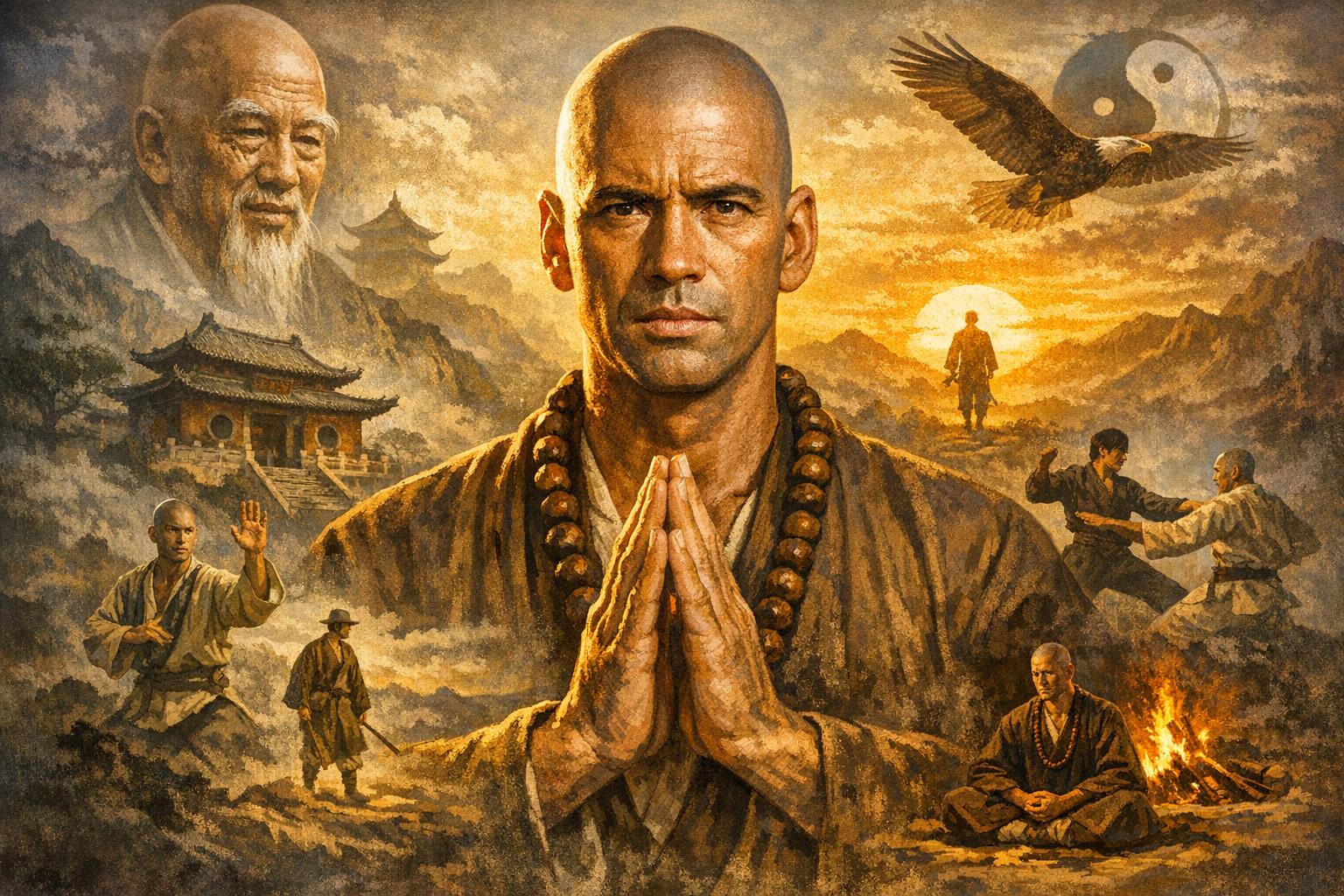
The Early Life and Training of Kwai Chang Caine
Kwai Chang Caine, portrayed by David Carradine in the television series Kung Fu, is depicted as a man of mixed Chinese and American heritage whose formative years shape a distinctive spiritual and philosophical outlook. Born to a Chinese mother and an American father, Caine’s early life is marked by displacement and adaptation. After being orphaned, he is brought to the Shaolin Temple, where he is raised by monks who recognize both his vulnerability and his potential. Within the monastery walls, he receives not only shelter but also an education that integrates intellectual discipline, moral instruction, and rigorous martial arts training.
Life at the Shaolin Temple is structured and demanding. From childhood, Caine’s daily existence is guided by ritual, study, and physical conditioning. He learns to rise before dawn, to meditate in stillness, and to approach even the simplest tasks with attentiveness. The temple environment emphasizes repetition and endurance, reinforcing that mastery arises from patience rather than speed. Senior monks serve as mentors, particularly Master Po and Master Kan, who provide instruction through parables, demonstrations, and carefully framed challenges. Rather than offering straightforward answers, they encourage Caine to develop insight through reflection.
Training in martial arts is comprehensive. Caine studies forms, weapons, balance, and the controlled application of force. Physical hardship is accepted as part of growth. Exercises designed to test stamina are paired with intellectual exercises that test perception and ethical reasoning. The monks stress that martial ability divorced from moral clarity can become destructive. Accordingly, Caine’s education integrates philosophy, language, calligraphy, and the principles of healing arts. This broad foundation reflects the Shaolin tradition, which regards the cultivation of the whole person as essential.
While Caine faces moments of doubt and frustration, these experiences are treated as opportunities for discipline. The temple culture encourages acknowledgment of weakness without self-indulgence. As a result, Caine develops a quiet demeanor and measured habits of thought. His teachers correct him firmly but avoid cruelty, guiding him toward self-awareness rather than punishment for its own sake. Over time, Caine earns the status of a monk and demonstrates proficiency that signals both technical competence and spiritual maturity. Yet his journey within the temple does not shield him from the external forces that will eventually disrupt his life.
The Shaolin Philosophy
The guiding framework of Caine’s development lies in the teachings attributed to the Shaolin tradition, which combine elements of Chan Buddhism, Taoist thought, and pragmatic ethics. Central to these teachings is the proposition that harmony emerges from alignment between mind, body, and environment. The monks instruct Caine that aggression fueled by ego is a sign of imbalance, while controlled strength applied in defense of justice reflects disciplined awareness. Meditation functions as a primary tool for cultivating this awareness.
Mindfulness is emphasized not as abstraction but as practical orientation. Caine learns to observe his surroundings carefully, to listen before responding, and to evaluate intention before action. His teachers frequently use metaphor drawn from nature—water flowing around obstacles, bamboo bending in the wind—to illustrate adaptability. Such imagery reinforces the idea that resilience does not always require confrontation. Flexibility and patience are framed as strategic advantages rather than signs of weakness.
The Shaolin code presented in the series also underscores compassion. Caine is repeatedly reminded that each person he encounters operates within circumstances shaped by fear, desire, or misunderstanding. Recognizing this does not require passive acceptance of wrongdoing; instead, it calls for proportionate response. Violence, though not categorically forbidden, is considered a last resort when all other efforts at resolution have failed. This hierarchy of response shapes Caine’s conduct long after he leaves the monastery.
Another element of Shaolin philosophy present in Caine’s education is the concept of non-attachment. The monks instruct him to avoid excessive identification with pride, status, or material gain. Impermanence is acknowledged as a universal condition. By understanding change as inevitable, Caine is prepared to endure loss without losing direction. This philosophical grounding becomes particularly significant when circumstances force him into exile.
Instruction at the temple also integrates paradox as a teaching device. Questions are answered with further questions, and apparent contradictions are left unresolved so that the student must reconcile them internally. Caine’s exchanges with Master Po often feature simple yet layered dialogue. These conversations demonstrate that knowledge is not solely the accumulation of facts but the refinement of perception. By internalizing such principles, Caine emerges from training with a framework that guides conduct beyond the monastery walls.
The Incident and Departure from the Monastery
Caine’s disciplined life at the Shaolin Temple is disrupted by political conflict beyond his control. The catalyst for his departure occurs when the Emperor’s nephew visits the temple and behaves with hostility toward its inhabitants. During a confrontation, Master Po is killed by the imperial relative. Faced with imminent danger and the loss of his mentor, Caine responds decisively. In defending himself and the temple, he kills the Emperor’s nephew.
This act has immediate and severe consequences. Taking the life of a member of the imperial household renders Caine a fugitive under Chinese law. His decision to use lethal force stands in tension with the teachings he has internalized, yet it is framed as an act of protection rather than vengeance. The gravity of the event forces Caine to evaluate the practical limits of nonviolence. He must reconcile his principles with the reality that passivity would have resulted in further injustice.
The temple community recognizes that Caine cannot remain without inviting retribution. With measured acceptance, he prepares to leave the only home he has known. His departure is not depicted as a rejection of Shaolin teachings but as the extension of them into uncertain terrain. Caine carries with him memories of his teachers, their lessons serving as internal guides in the absence of physical sanctuary. The transition marks a shift from structured instruction to experiential testing.
Flight requires stealth and resilience. Caine travels across China before securing passage to the United States. The journey symbolizes more than geographic relocation; it represents entry into an environment lacking familiar cultural and philosophical supports. His mixed heritage becomes more visible in the American context, placing him between identities. This position complicates his search for anonymity and belonging.
Caine’s exit from the monastery underscores a broader theme: disciplined training does not eliminate unpredictability. Instead, it prepares an individual to respond with stability. The episode that renders him an exile becomes the proving ground for his understanding of restraint, responsibility, and proportionate force. From this point forward, his life unfolds as an itinerant search shaped by necessity rather than intention.
Wandering in America
Upon arriving in the American West, Caine becomes a wanderer moving through frontier towns shaped by rapid expansion, economic disparity, and fragile legal structures. The cultural environment differs sharply from the ordered routines of the Shaolin Temple. Industrial development, racial prejudice, and opportunism characterize many of the communities he traverses. In this setting, Caine frequently encounters suspicion due to his appearance and quiet demeanor.
Employment for a transient laborer in the nineteenth-century American West is unstable. Caine works as a railroad laborer, ranch hand, and general worker. These occupations place him among individuals facing economic hardship and social marginalization. Through these interactions, he observes parallels between the suffering he witnessed in China and the struggles present in American frontier society. His responses to injustice are informed by his training but adapted to local realities.
Conflict is a recurring feature of his travels. Towns often lack effective governance, leading individuals to resolve disputes through intimidation or violence. Caine’s approach distinguishes him from many contemporaries. He attempts dialogue before combat, applying measured language and composed bearing to defuse aggression. When confronted physically, he defends himself with efficiency, using minimal force required to neutralize threats. The visual contrast between stillness and sudden action reinforces his internal discipline.
Racial discrimination presents an additional challenge. As a man of Asian heritage in a period marked by exclusionary attitudes, Caine encounters hostility rooted in prejudice. His response reflects both endurance and strategic restraint. Rather than engaging every insult, he conserves energy for situations requiring tangible intervention. This selective engagement aligns with Shaolin principles that counsel discernment in the use of strength.
Throughout his wanderings, Caine seeks information about his half-brother, whom he hopes to find and reconnect with. This objective provides continuity amid transience. Yet the search is conducted without urgency that compromises his ethical grounding. He remains attentive to immediate circumstances, offering assistance where he can. His interventions often center on protecting vulnerable individuals from exploitation, thereby translating philosophical commitments into practical action.
Flashbacks to the monastery punctuate his experiences in America. In moments of uncertainty, memories of conversations with Master Po or demonstrations by Master Kan surface. These recollections function as interpretive tools rather than nostalgic refuge. They remind Caine to re-evaluate immediate impulses and consider broader consequences. The integration of past instruction with present demands illustrates the durability of formative training.
Caine’s presence in diverse communities exposes him to multiple belief systems and customs. Rather than imposing his own views, he observes and adapts. This adaptability does not imply lack of conviction; instead, it reflects confidence in foundational principles that can coexist with variation. His conduct suggests that philosophical identity need not require cultural isolation. In this way, his journey in America becomes a process of translation, rendering Shaolin teachings intelligible within a frontier context.
While episodes of violence occur, they do not define his character. More frequently, Caine’s influence appears through subtle shifts in others’ behavior. A measured explanation, a gesture of restraint, or a refusal to escalate conflict often alters outcomes. These interactions contribute to a reputation that precedes him in some regions, portraying him as a capable yet reserved figure who avoids unnecessary confrontation.
Legacy of Kwai Chang Caine
The character of Kwai Chang Caine occupies a distinctive place in American television history. As a central figure in a Western setting shaped by Eastern philosophical influence, he represents a hybrid narrative form. His story brings martial arts traditions and contemplative discourse into a genre historically dominated by direct conflict and frontier justice. This synthesis broadened portrayals of strength on screen, suggesting that endurance and reflection could be as compelling as aggression.
Caine’s legacy also extends to the depiction of cross-cultural identity. His mixed heritage and displacement position him between worlds. Rather than resolving this tension through assimilation or rejection, the narrative presents integration as a continuous process. His conduct demonstrates that identity can remain stable even when geographic and social contexts change. This portrayal contributed to discussions about representation and cultural exchange in media.
The influence of Shaolin philosophy within the series introduced audiences to concepts such as mindfulness, non-attachment, and measured response. While adapted for dramatic purposes, these ideas encouraged viewers to consider alternative approaches to conflict resolution. Caine’s reliance on dialogue before force contrasts with dominant archetypes of the era. In doing so, the character offered a counterpoint to portrayals equating authority solely with physical dominance.
From a narrative perspective, Caine’s wandering structure allowed episodic exploration of moral dilemmas. Each community he entered presented localized challenges, yet underlying themes remained consistent. The repetition of encounter, reflection, and calibrated response reinforced the stability of his training. His life did not culminate in permanent settlement or conventional triumph. Instead, it illustrated continuity of purpose amid movement.
The endurance of the character in popular memory reflects the coherence between his early training and later conduct. The discipline instilled at the Shaolin Temple persists despite exile, loss, and adversity. This continuity affirms the premise that philosophical grounding can provide orientation independent of circumstance. Caine’s story depicts resilience not as rigidity but as sustained balance.
In broader cultural terms, the series contributed to increased interest in martial arts and Eastern philosophy in Western contexts during the 1970s. While fictionalized, the character’s measured demeanor and emphasis on introspection resonated with audiences seeking alternatives to prevailing models of heroism. The narrative’s blending of action and contemplation created space for discourse about ethics, identity, and self-mastery within mainstream entertainment.
Kwai Chang Caine’s journey from orphaned child to Shaolin monk and itinerant figure in the American West forms a cohesive arc grounded in disciplined formation. His early life establishes the intellectual and moral structures that guide later decisions. The incident that compels his departure serves as a test of principle under extreme pressure. His subsequent wanderings demonstrate application of those principles in complex environments. Collectively, these elements define a legacy centered on sustained integration of mind, body, and conduct across shifting landscapes.
This article was last updated on: July 7, 2026