

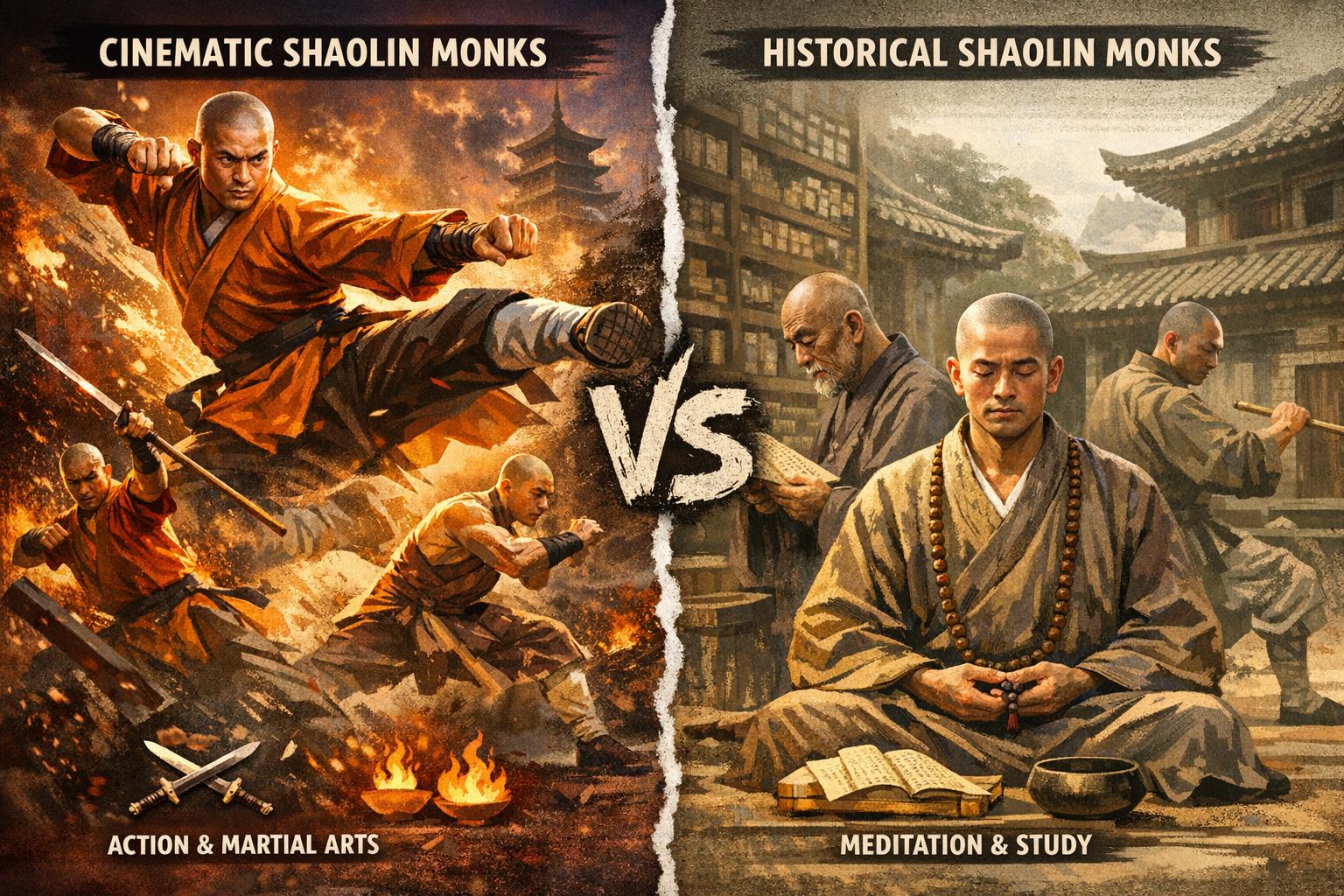
The Portrayal of Shaolin Monks in Cinema
The depiction of Shaolin monks in cinema has developed into one of the most recognizable images in martial arts storytelling. Films produced in Hong Kong, mainland China, and later in Western studios have presented these monks as figures who combine extraordinary combat ability with disciplined spirituality. Through carefully choreographed fight scenes and symbolic storytelling, filmmakers have shaped a global perception of the Shaolin tradition. While such portrayals draw upon historical elements, they frequently amplify or simplify those elements to fit narrative expectations, visual spectacle, and commercial appeal.
The cinematic image of a Shaolin monk is immediately identifiable: a shaved head, flowing robes, minimal possessions, and exceptional physical control. He appears calm under pressure, guided by a strict moral code, and capable of overcoming opponents through both mental clarity and refined physical technique. This representation carries persuasive visual power. However, it also merges documented historical practice with dramatic invention, often transforming a complex monastic tradition into a stylized archetype. Recognizing this distinction provides insight into how popular culture reshapes historical realities.
Martial Arts Skills and Techniques
Cinema consistently emphasizes the martial dimension of Shaolin identity. Many films portray monks as masters of Kung Fu whose abilities exceed ordinary human limits. Characters leap across rooftops, balance on spear tips, endure heavy blows without visible injury, or defeat multiple attackers with rapid precision. These scenes are designed to demonstrate controlled strength and disciplined movement, framing the monks as the ultimate expression of physical refinement.
Historically, the Shaolin Temple did contribute significantly to the preservation and development of martial practice. Records from the Ming dynasty mention monks engaging in military action and training in staff fighting. Martial exercises functioned as a form of physical conditioning, a method of self-defense, and occasionally a means of institutional protection during periods of instability. Nevertheless, the practical objectives of training were grounded in survival and discipline rather than theatrical display. Techniques were cultivated for efficiency and repeatability, not spectacle.
Film choreography, by contrast, emphasizes visual impact. Movements are exaggerated for camera angles and audience engagement. Wirework, editing, and stunt performance expand what the human body can plausibly achieve. This stylization does not necessarily reject tradition but transforms it into symbolic gesture. A slow sweeping kick becomes a visual metaphor for balance; a suspended leap conveys transcendence. In this way, martial technique is translated into cinematic language.
Another common cinematic theme is the idea of secret or forbidden techniques passed from master to disciple. These skills often appear as hidden scrolls, coded manuals, or ancient forms rediscovered at critical moments. While traditional martial arts lineages do place importance on direct transmission and mentorship, the myth of rare, nearly magical techniques is largely a product of storytelling. Real training would have centered on repetitive practice, endurance, and incremental mastery rather than sudden revelation.
Philosophical and Spiritual Practices
Beyond combat, films frequently depict Shaolin monks as embodiments of philosophical insight. They are portrayed as protectors of sacred knowledge, able to resolve conflict through calm reasoning or disciplined restraint. Scenes often show extended meditation, debates on moral principles, or lessons delivered through metaphor. These features reflect the association between Shaolin and Chan Buddhism, which emphasizes meditation and direct experiential insight.
Historically, spiritual study formed the foundation of monastic life. Monks followed a schedule that integrated meditation, scripture recitation, manual labor, and communal meals. The integration of mind and body was not conceived as mystical spectacle but as daily discipline. Even martial exercise was often framed as a method of cultivating awareness and self-control. The spiritual identity of the temple cannot be separated from its physical training, yet neither dimension dominated the other exclusively.
Film narratives, however, tend to condense Buddhist philosophy into concise statements or dramatic turning points. A senior monk might summarize ethical teaching in a single exchange, after which the protagonist undergoes rapid transformation. Enlightenment is sometimes presented as an achievement unlocked through physical endurance or the completion of a challenge. By contrast, the historical understanding of spiritual progress within Buddhism involves gradual development sustained over years of disciplined practice.
Mystical elements sometimes appear in cinematic portrayals. Monks may demonstrate heightened perception, extraordinary resilience, or subtle control over internal energy. While concepts such as qi circulate within Chinese philosophical traditions and have influenced martial arts theory, the representation of supernatural outcomes often exceeds traditional descriptions. Cinema uses these motifs to enhance narrative tension and symbolic depth, even when departing from doctrinal nuance.
Ascetic Lifestyle
A recurring theme in film is the austere isolation of the Shaolin Temple. Surrounded by mountains and forests, the monastery appears detached from political authority and social life. Monks are shown renouncing worldly connections, maintaining sparse living conditions, and devoting themselves entirely to discipline. This image reinforces the perception of Shaolin as a sanctuary removed from corruption.
Historical evidence suggests a more interactive reality. The Shaolin Temple in Henan Province functioned as a religious institution embedded in broader social structures. It received patronage, land grants, and donations. Monks engaged with pilgrims, scholars, and local residents. Agricultural management and property concerns required organized administration. Although discipline was central to monastic identity, the temple did not operate in complete isolation from society.
The cinematic preference for separation serves narrative efficiency. By positioning the monastery as a retreat, filmmakers establish a moral contrast between ordered spiritual life and chaotic external forces. When conflict invades the temple, it symbolizes disruption of harmony. The destruction or defense of Shaolin in film thus carries symbolic meaning beyond physical confrontation.
Living conditions in film are also simplified. Bare chambers, minimal furnishings, and silent corridors dominate visual composition. Historical dormitories and halls would have contained functional arrangements suited to communal life. The difference is not that monks lived luxuriously but that daily reality involved practical detail absent from stylized representation. Cinema favors visual clarity, reducing environmental complexity to highlight character action.
Role in Society
One of the most persistent cinematic narratives presents Shaolin monks as righteous defenders who oppose corrupt officials or foreign invaders. Individual monks often leave the temple to avenge injustice, protect villages, or confront tyrants. This storyline reinforces the archetype of the warrior monk who balances compassion with decisive action.
Historical accounts indicate that the temple occasionally engaged in military support, particularly during certain dynastic conflicts. Such involvement, however, was episodic rather than constitutive of constant vigilante activity. The primary function of the monastery remained religious observance and community management. Participation in armed defense was usually situational and influenced by regional politics.
The transformation of monks into heroic protagonists aligns with broader genre conventions in martial arts cinema. Audiences expect clear antagonists and climactic confrontations. By placing a disciplined monk in opposition to moral disorder, filmmakers construct a narrative of integrity confronting chaos. The monk’s training becomes both literal preparation and symbolic justification for intervention.
Films also tend to individualize heroism. A single monk’s journey becomes central, emphasizing personal growth and redemption. In contrast, historical monastic life emphasized collective identity. Ritual, study, and work were performed communally. Authority derived from hierarchical structures within the temple, not from isolated acts of heroism. The cinematic focus on individual agency mirrors modern storytelling norms rather than monastic organization.
Transmission Through Global Cinema
The portrayal of Shaolin monks has not remained confined to Chinese-language productions. International films and television series have adopted the image, adapting it to diverse cultural contexts. Sometimes the Shaolin figure appears directly; at other times, the archetype informs fictional monasteries with similar philosophy and training. The global dissemination of these portrayals has contributed to a standardized popular image of the Shaolin monk as a universal symbol of disciplined martial spirituality.
In this process, cultural translation shapes representation. Western productions may emphasize exoticism, framing the monastery as mysterious or ancient beyond measure. Dialogue may simplify philosophical nuance into broadly accessible themes such as perseverance or inner peace. While such adaptations expand recognition of the Shaolin name, they can also detach it from specific historical conditions.
At the same time, the influence of cinema has affected modern perceptions within China. Contemporary demonstrations and performances sometimes align with cinematic expectations, highlighting acrobatics and coordinated displays. The relationship between historical tradition and modern performance is therefore dynamic. Film draws on tradition, and public performance may in turn reflect film’s visual vocabulary.
Balancing Representation and Historical Context
Cinematic portrayals of Shaolin monks function as cultural narratives rather than academic reconstructions. They condense centuries of development into coherent and visually engaging forms. The monks appear as guardians of continuity in periods of upheaval, as disciplined seekers in times of moral ambiguity, and as embodiments of integrated mind and body. These portrayals fulfill narrative requirements and resonate across audiences.
The historical Shaolin tradition, when examined through records, archaeology, and doctrinal study, appears more complex and context-dependent. It involves adaptation to political change, negotiation of economic realities, and internal diversification of practice. Martial training, spiritual cultivation, and community engagement existed in interdependent balance. None operated independently of material considerations.
Understanding these distinctions does not require dismissing cinematic representations. Rather, it situates them within the broader process through which cultures interpret their past. Films transform historical themes into accessible imagery. They create stylized figures who communicate ideas about discipline, integrity, and resilience. At the same time, historical inquiry reveals institutional nuance and practical detail absent from narrative simplification.
In summary, the portrayal of Shaolin monks in cinema emphasizes extraordinary martial skill, concentrated spiritual insight, and principled intervention in social conflict. These elements draw from documented aspects of Shaolin history yet amplify them for dramatic coherence. The historical monks practiced disciplined training, engaged with surrounding communities, and participated in Buddhist study within structured monastic life. The cinematic monk represents a distilled and intensified version of these traits. Recognizing both dimensions allows for appreciation of the artistic construction while maintaining awareness of the multifaceted historical tradition from which it emerged.
This article was last updated on: May 5, 2026