

Introduction
Kung Fu, a term widely used to describe the diverse traditions of Chinese martial arts, represents a disciplined system of physical training, ethical cultivation, and philosophical reflection. Although it is commonly associated with combat techniques, its historical development demonstrates that it has long served broader cultural and social purposes. Within Chinese society and later across global communities, Kung Fu has functioned as a framework for personal refinement and social responsibility. Central to its development is the idea that mastery involves more than physical strength; it requires intellectual clarity, moral steadiness, and an ability to relate constructively to others.
Throughout history, martial practices have sometimes been associated with conflict or exclusivity. However, the philosophical underpinnings of Kung Fu present an alternative perspective in which discipline and self-control are intended to reduce harm rather than encourage it. By emphasizing awareness, patience, and humility, Kung Fu has contributed to conversations about prejudice and acceptance in multiple cultural contexts. As it spread beyond China, especially during the twentieth century, it became not only a system of combat training but also a vehicle for cross-cultural dialogue. Through media representation, diaspora communities, and international schools, Kung Fu has influenced public understanding of Chinese culture while simultaneously challenging simplistic or stereotypical views.
In examining Kung Fu’s role in addressing prejudice, it is important to consider its philosophical origins, its historical portrayal in popular media, its influence within Western societies, and its ongoing contributions to multicultural learning environments. Together, these dimensions demonstrate how a martial art can function as a structured method for encouraging respect and intercultural understanding.
Philosophical Foundations
At the core of Kung Fu lies a commitment to self-cultivation. The literal meaning of the term “gongfu” in Chinese refers to skill developed through sustained effort over time. This definition extends beyond martial ability to encompass moral and intellectual growth. In traditional training halls, instructors frequently stress that technical proficiency must be accompanied by ethical conduct. Respect for teachers, fellow students, and even opponents forms a consistent part of instruction. Such expectations are not peripheral customs; they are integral components of the discipline.
These principles reflect the influence of several major Chinese philosophical traditions. Confucianism emphasizes hierarchical respect, social harmony, and moral duty. Within a Kung Fu school, these values appear in rituals such as formal greetings, acknowledgment of lineage, and the structured relationship between teacher and student. The aim is not blind obedience but the cultivation of responsibility and mutual regard. When practitioners internalize these practices, they learn to consider how their actions affect others, which reduces tendencies toward prejudice based on ignorance or assumption.
Daoism also informs the internal framework of many Kung Fu systems. Daoist philosophy encourages balance, adaptability, and an understanding of natural interdependence. Concepts such as yielding to overcome force highlight a practical method of managing conflict without escalating it. Applied beyond physical technique, this principle can foster open-mindedness. By learning to respond flexibly rather than rigidly, practitioners are less likely to hold fixed negative judgments about unfamiliar groups or ideas.
Additionally, in systems associated historically with the Shaolin Temple, Buddhist teachings contribute ideals of compassion and mindfulness. Meditation practices integrated into training sessions encourage practitioners to examine their thoughts and emotional reactions. When individuals become more aware of internal bias or reactive tendencies, they are better positioned to correct them. In this way, philosophical instruction acts as a safeguard against prejudice by requiring introspection and accountability.
The shared emphasis across these traditions is that external skill is insufficient without internal refinement. Strength without restraint is considered incomplete. Such a framework differs significantly from narratives that portray martial arts purely as instruments of dominance. By continuously reinforcing respect and balance, Kung Fu training establishes conditions under which acceptance becomes a logical extension of disciplined practice.
Historical Context
Kung Fu’s historical evolution reflects China’s complex social and political transformations. Regional styles emerged in response to local defense needs, family traditions, and monastic influences. Despite these varied origins, the art retained a consistent stress on personal integrity. Martial artists were often expected to embody upright conduct within their communities. Stories preserved in folklore and opera frequently depicted heroes who defended marginalized individuals or confronted injustice. Although these narratives should not be interpreted as literal historical accounts, they illustrate the association between martial ability and ethical duty in cultural memory.
As Chinese communities migrated abroad in the nineteenth and early twentieth centuries, Kung Fu traveled alongside them. In diaspora contexts, martial arts schools served as centers for cultural preservation. They allowed immigrants and their descendants to maintain connections to language, ritual, and shared history. At the same time, these schools sometimes faced suspicion or discrimination in host societies. Misunderstandings about secret societies or exotic practices contributed to prejudice against Chinese communities.
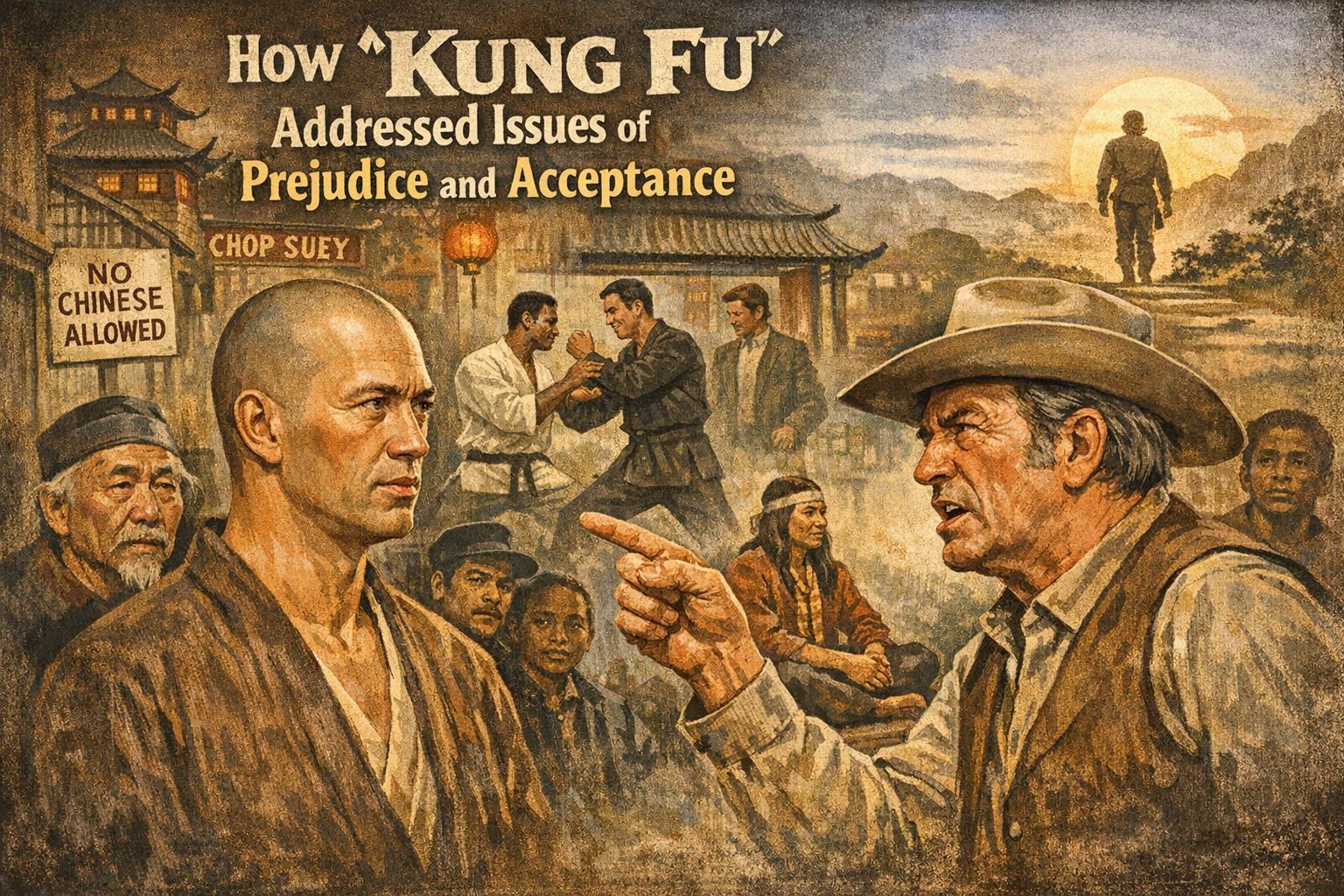
During the twentieth century, film and television became powerful mediums shaping international perception. The 1970s American television series Kung Fu portrayed a Shaolin monk of mixed heritage traveling across the American frontier. The character frequently responded to hostility with patience and measured restraint. Each episode explored scenarios in which cultural misunderstanding or outright prejudice generated conflict. Instead of resorting immediately to violence, the protagonist often attempted mediation and explanation. Physical confrontation occurred only when necessary for protection. This portrayal introduced many viewers to philosophical dimensions of Kung Fu, countering assumptions that non-Western traditions lacked ethical depth.
Cinema from Hong Kong also influenced global audiences. Directors and actors conveyed not only action choreography but also underlying themes of honor, loyalty, and perseverance. Although dramatized, these stories displayed martial artists as complex individuals navigating social injustice or national upheaval. The repeated emphasis on discipline and moral reflection contributed to a broader re-evaluation of Asian characters in international media, gradually challenging earlier caricatures.
Impact on Western Society
The arrival of Kung Fu schools in North America and Europe during the mid-twentieth century marked a significant cultural exchange. At first, instruction was often limited to Chinese communities. Over time, however, teachers began accepting students from diverse ethnic and religious backgrounds. This shift required careful negotiation of cultural expectations. Western students encountered new etiquette, terminology, and training methodologies. Learning to bow, address instructors formally, and participate in collective drills exposed students to unfamiliar norms that emphasized humility and shared effort.
One of the most influential figures in this period was Bruce Lee. Beyond his cinematic achievements, Lee articulated a philosophy that rejected rigid categorization. He argued that martial arts should be adaptable and accessible rather than confined by ethnicity or tradition. By openly teaching non-Chinese students at a time when this was controversial, Lee challenged exclusionary attitudes within and beyond martial arts communities. His insistence that combat principles were universal helped reframe Kung Fu as a human discipline rather than an exotic curiosity.
Lee’s presence in Hollywood also contributed to gradual changes in representation. Prior to his emergence, Asian characters were frequently depicted in limited or subordinate roles. Through leading performances that highlighted intelligence, discipline, and complexity, he broadened audience perceptions. While stereotypes did not disappear, the visibility of a confident and articulate martial artist of Asian descent disrupted prevailing narratives.
Beyond entertainment, Kung Fu schools in Western societies often functioned as informal cultural education centers. Students learned fragments of Chinese language, historical context, and philosophical ideas alongside physical techniques. This exposure encouraged intercultural dialogue. Misconceptions could be addressed directly through contact and conversation. In many cases, friendships formed across backgrounds that might otherwise have remained socially distant.
Community and Personal Growth
Within contemporary Kung Fu academies, diversity is a common feature. Classes frequently include participants of varying ages, professions, and national origins. The structured setting of training requires cooperation. Partner exercises depend on mutual trust. Students must calibrate their strength to avoid injury, reinforcing empathy and attentiveness. Through repeated interaction under shared rules, individuals build familiarity that reduces prejudice arising from unfamiliarity.
Regular practice also cultivates self-regulation. Techniques demand concentration and incremental improvement rather than immediate results. When students confront physical limitations or technical challenges, they are encouraged to respond with patience instead of frustration. This discipline translates into broader social interactions. Individuals accustomed to reflecting before reacting may be less inclined to express discriminatory assumptions impulsively.
Furthermore, the hierarchical yet supportive structure of many schools models a balanced authority system. Senior students guide beginners, demonstrating that leadership involves responsibility rather than domination. Because advancement is based on demonstrated skill and dedication rather than ethnic background or social status, meritocratic ideals become tangible. Observing diverse individuals progress through ranks can counter preconceived notions about capability tied to identity.
Community events such as demonstrations, cultural festivals, and seminars create additional opportunities for public engagement. Audiences encounter practitioners whose backgrounds vary widely yet who participate in a shared tradition. Such visibility underscores the idea that cultural practices can be respectfully adopted across boundaries without erasing their origins. In this way, Kung Fu becomes both a preserved heritage and a collaborative practice.
Personal narratives from practitioners frequently describe increased confidence paired with heightened respect for difference. While experiences vary, a consistent theme is that disciplined training reduces fear of the unfamiliar. When individuals become secure in their own abilities and identities, they may feel less threatened by diversity. This psychological dimension contributes indirectly to greater social acceptance.
Conclusion
Kung Fu’s historical trajectory demonstrates that a martial art can extend beyond technical instruction to function as a structured approach to ethical development and intercultural engagement. Rooted in philosophical traditions that emphasize harmony, balance, and responsibility, Kung Fu integrates physical rigor with reflective practice. Its migration across continents introduced new audiences to these values, reshaping perceptions and challenging simplified stereotypes.
Through media representation, influential practitioners, and the everyday operations of training schools, Kung Fu has contributed to ongoing discussions about prejudice and acceptance. By insisting that strength must be guided by restraint and that mastery requires humility, it offers a model in which personal development and social responsibility are interconnected. As contemporary communities continue to diversify, the disciplined yet inclusive framework of Kung Fu remains relevant, demonstrating how cultural traditions can support mutual respect while preserving their distinct historical foundations.
This article was last updated on: May 19, 2026